
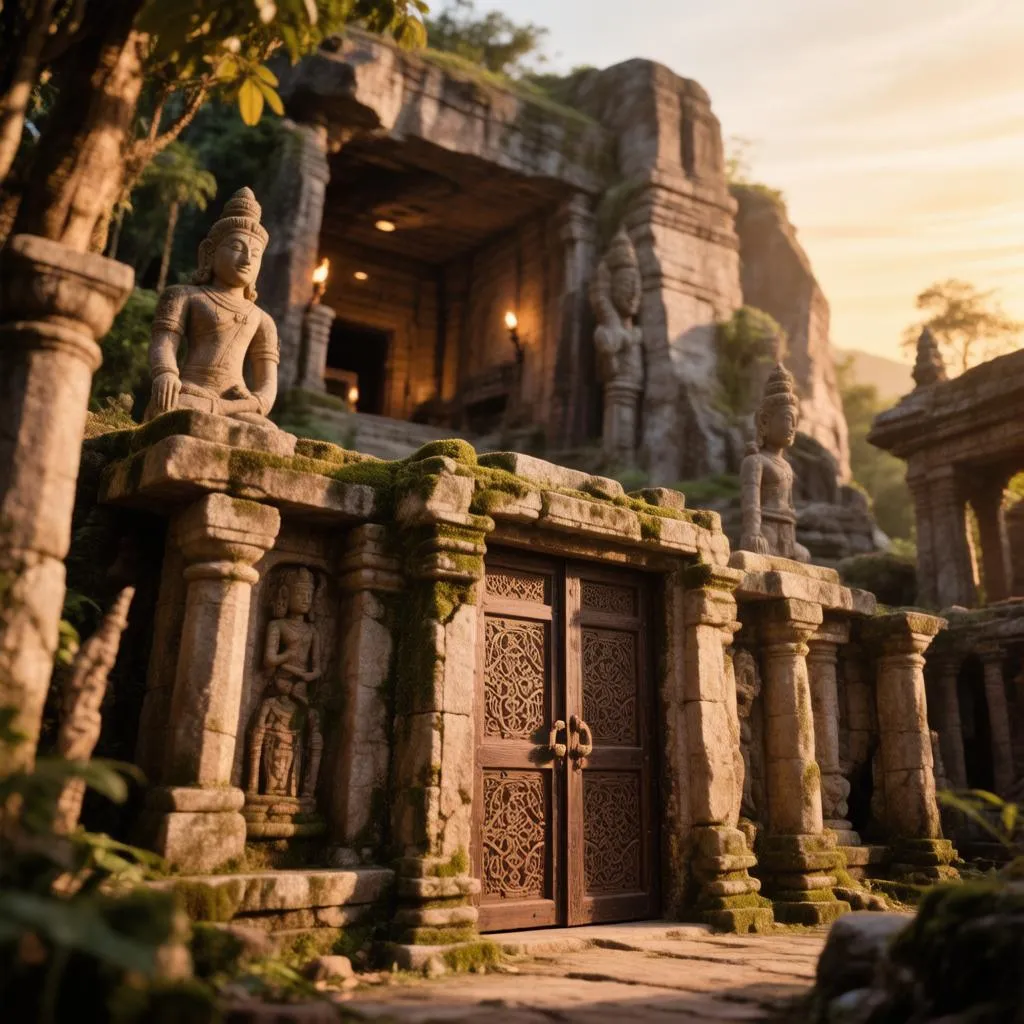
India’s temple landscape holds more than architecture and ritual. Scattered across the subcontinent are shrines built around genuine unsolved puzzles — vaults sealed for over a century by courts and curses, limestone caves that Hindu texts describe as a full underground city, flames that have burned without fuel for thousands of years, and lingams that turn colour with the moon’s phases. Some of these mysteries have scientific explanations waiting to be confirmed; others sit comfortably in the territory of legend, where faith and folklore refuse to be separated. What they share is a power over the imagination that no polished modern temple can match. This journey moves through the strangest of them, from a treasure guarded by a serpent god to a door that opens once in sixty years.
Vault B: the treasure no one dares open
Sri Padmanabhaswamy Temple in Thiruvananthapuram, Kerala, became world-famous in 2011, when a Supreme Court-ordered inventory of its underground chambers revealed treasure now estimated at over $20 billion — gold idols weighing 30 kilograms, diamond-studded crowns, sacks of coins minted centuries ago. Six vaults were opened and documented. The seventh, known as Vault B or the Bharatakonnu vault, was not.
The reason is written into belief. Vault B is said to be guarded by a fierce serpent deity — Nidhi Vinayaka, the elephant-headed god watching over hidden treasure — and its two iron doors carry cobra carvings with no keyhole, lock or latch. Local tradition holds that the door was sealed by the tantri (temple priests) chanting a serpent curse, and that opening it improperly invites catastrophe. Two granite walls were reportedly placed before it in 1908, and when a courtroom advocate suggested examining it, family elders warned of the wrath of the god. The Supreme Court’s commission ultimately deferred to the temple’s religious leadership, and the doors remain shut to this day. Engineers who studied the structure believe the vault may be a genuinely impenetrable chamber — possibly a complete wall built around the original entrance rather than a door at all — which would make it one of the few rooms on Earth whose contents are literally unknowable.
What makes the legend more unsettling is what happened around it. A handful of deaths and misfortunes involving people connected to the inventory process were woven into the narrative by believers, though sceptics note that coincidences thrive on any story this old. The Indian Council of Historical Research has proposed non-invasive study; the temple trust has resisted. Vault B keeps its secret, and Kerala keeps its debate.
Patal Bhuvaneshwar: a city beneath a mountain
In the Kumaon hills of Uttarakhand, 90 kilometres from the nearest railway line, a limestone cave system runs 160 metres long and at least 90 metres deep, and Hindu scripture does not call it a cave at all. The Skanda Purana names Patal Bhuvaneshwar as the abode of 33 crore gods — the entire pantheon housed in stone beneath the village of Bhubaneshwar. Medieval texts add a timeline: the cave is said to hold the head of Ganesha, the body of Adi Kailash, the tongues of Kalagni, and the feet of Vishnu, with a serpent named Sheshnag serving as its guardian.
Modern visitors descend a single red-lit staircase into a world of stalagmites that priests have spent centuries naming — formations shaped like Ganesha, Shiva’s locks, and a set of legs and a torso that locals identify as the feet of Sheshnag himself. The experience is as much geology as theology, but the naming tradition runs so deep that the cave functions as a sacred map of the cosmos. A prophecy attached to it adds urgency: the texts claim that when the world ends, Kaliyug, will end inside this cave. Whatever one makes of that, the shrine has drawn pilgrims since at least the 12th century, when the philosopher Adi Shankaracharya is said to have discovered it.
Flames, colours and vanishing deities
Not every mystery involves stone and gold. Several of India’s strangest temples rest on phenomena that straddle the line between physics and faith. The most celebrated:
- Jwala Devi, Himachal Pradesh. The temple has no idol — its sanctum holds a rock fissure from which natural gas seeps and burns in a perpetual blue flame, worshipped as the tongue of the goddess Sati. The flame has burned continuously through centuries, and the court of Mughal emperor Akbar reportedly attempted to douse it with a heavier-than-water liquid, failing spectacularly. Geologists explain the flame as methane escaping through fissured rock; devotees see the goddess breathing.
- Nidhivan, Vrindavan. A walled grove of twisted, hollow trees where, according to belief, Krishna still performs his nightly ras-lila dance. Every evening the priest secures the gates, places a meal, and a bed is made in the Rang Mahal — and by morning, the bed is said to appear used, with objects rearranged. Visitors are forbidden to stay after dark, and locals report that watching from the walls brings blindness or madness.
- Panchavarnaswamy Temple, Tamil Nadu. The lingam here is believed to change colour five times a day — reflecting or appearing as copper at dawn, fire-red at noon, gold in the afternoon, emerald at dusk and a fifth shade by night — synchronised with the sun’s journey. Skeptics attribute it to light and mineral surfaces; the temple treats it as the five faces of Shiva.
- Ranganatha Swamy, Srirangapatna. The reclining Vishnu is said to face west, a direction no other Vishnu idol in the tradition faces, believed to be turned so as to watch over devotees in a specific mythological moment.
- Chottanikara Bhagavathy, Kerala. The temple is associated with exorcism rituals, and legend holds that the devi’s murti was originally on the sand of the nearby ground before being installed, its base still showing footprints.
Each shrine survives on the tension between what can be measured and what has been believed for centuries — and in India, that tension has produced some of the most enduring pilgrimage sites on the planet.
The door that opens once in sixty years
Kedarnath in the Himalayas is not mysterious because anything is hidden — it is mysterious because of when it is shut. The temple closes for winter, and before the gates seal, a ceremony called the Bhog-e-Fal feeds the deity items including dried fruits and akhrot (walnuts), believed to remain with the god through the six months of closure. Priests and locals maintain that no human presence remains; when the temple reopens in spring, the lamps are said to still be burning and the flowers fresh — claims that have never been independently verified, because verifying them would mean staying inside the sealed temple through a Himalayan winter. Meanwhile, the akhrot ritual carries a folk version: devotees believe the deity consumes the offering, and the leftover walnut shells are treated as blessed.
The same temple holds a second enigma: the 16th-century construction sits on a glacial moraine, and the 2013 floods that devastated the valley around it left the main sanctum standing while structures nearby were flattened. Engineering explanation or divine protection depends on who is telling the story, and the temple refuses to resolve the question.
Mapping the enigmas
The shrines described so far differ in what kind of mystery they hold, and laying them side by side clarifies which are physical puzzles, which are traditions of belief and which are both:
| Temple | Location | Core mystery | Type of mystery |
|---|---|---|---|
| Padmanabhaswamy (Vault B) | Thiruvananthapuram, Kerala | Sealed doors with no lock; contents unknown | Physical and legal |
| Patal Bhuvaneshwar | Pithoragarh, Uttarakhand | Underground cave said to house the pantheon | Geological and scriptural |
| Jwala Devi | Kangra, Himachal Pradesh | Eternal flame with no fuel | Scientific and devotional |
| Nidhivan | Vrindavan, Uttar Pradesh | Nightly divine dance; locked grove | Ritual and folklore |
| Panchavarnaswamy | Tiruvaiyaru, Tamil Nadu | Lingam shifting colour five times a day | Optical and theological |
The table underlines why these sites resist easy classification. Padmanabhaswamy’s vault is a genuine material unknown — a locked room whose contents could alter history books. Jwala Devi’s flame is a natural phenomenon wrapped in worship. Nidhivan and Patal Bhuvaneshwar live almost entirely in tradition, and Panchavarnaswamy sits somewhere between optics and ritual. India’s temple mysteries are not one phenomenon but a spectrum, which is part of why they endure.
Planning a visit to the enigmatic temples
Chasing these mysteries requires more planning than a standard temple circuit, because several of the sites are remote, seasonal or access-restricted. A little preparation prevents disappointment:
- Time the mountains. Patal Bhuvaneshwar stays open year-round, but the road to Kedarnath closes in winter; the Char Dham season runs roughly from late April or May to October, with exact dates announced annually.
- Respect the rules of belief. Nidhivan closes its gates at night with no exceptions; Jwala Devi’s sanctum can be photographed only from outside; Patal Bhuvaneshwar permits no cameras, leather or fireworks inside. Breaking the local rules does not just offend — it ends the visit immediately.
- Check the darshan systems. Padmanabhaswamy requires a dress code for all visitors (dhoti or mundu for men, saris or salwar for women) and issues entry tokens; modern temples increasingly use online booking, so verify before travelling.
- Build in travel time. The Kumaon cave is a full-day drive from Kathgodam; the Kangra shrine sits a few hours from Pathankot. These are not half-day excursions from a city hotel.
- Travel with the monsoon in mind. Himalayan temples shut or become hazardous during heavy rain; Kerala and Tamil Nadu sites stay accessible but humid.
Done carefully, the circuit rewards patience with something rare — the sense of walking into a question rather than an answer.
Why the mysteries endure
Science has explanations for Jwala Devi’s flame and plausible theories for Panchavarnaswamy’s colour shifts, and that is exactly what makes these temples fascinating rather than debunked. The mystery was never only about the mechanism; it is about what a community chooses to build around an unexplained thing — a court order protecting a vault, a prophecy attached to a cave, a nightly bed made for a god who may or may not sleep there. In India, where religion, folklore and daily life are braided together, the temple is not a museum of the inexplicable but a living argument between the past and the present. The doors that never open, the cities that lie underground and the legends that outlast every rationalist continue to draw millions precisely because they leave room for both the believer and the skeptic to walk out of the same shrine having seen something different. That, in the end, is the most Indian mystery of all.