
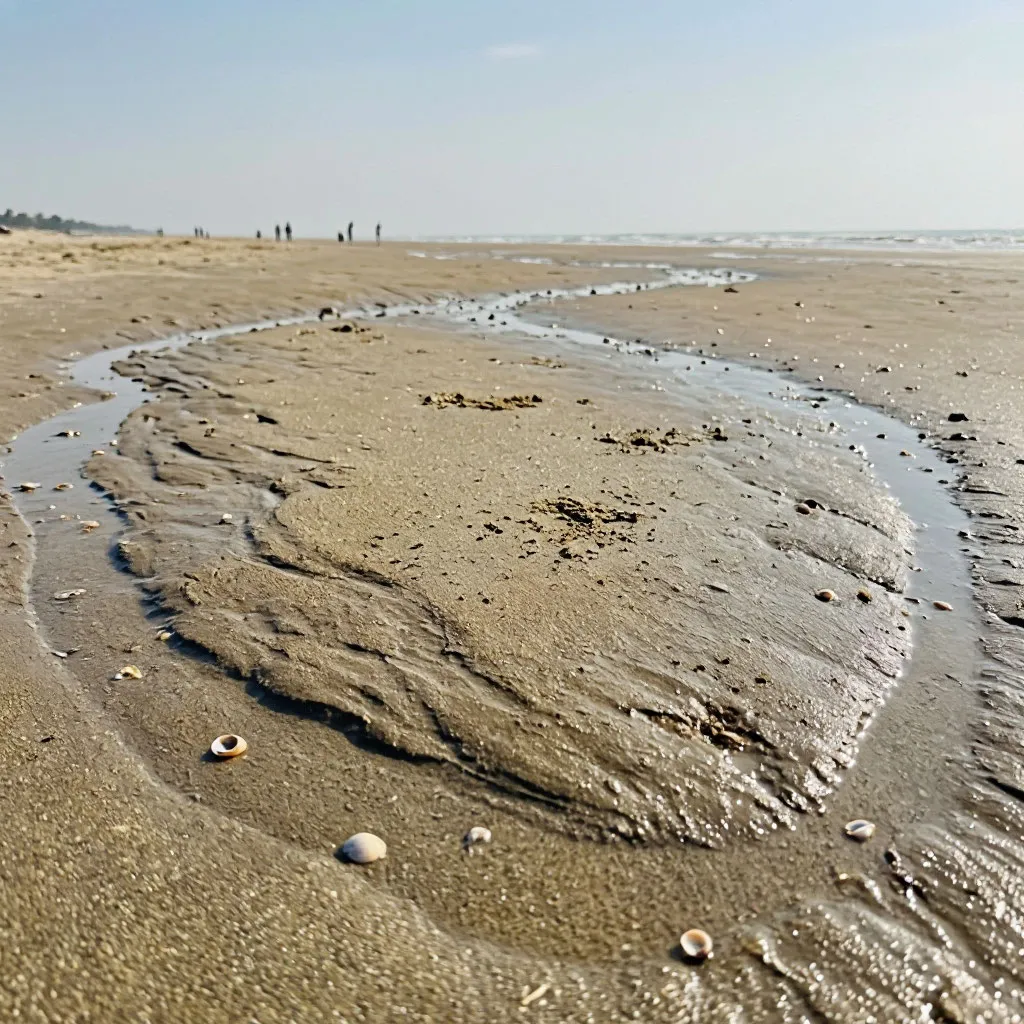
Imagine standing on a beach in the morning, watching waves lap at your feet — and then returning a few hours later to walk five kilometres across the same spot, dry-shod, with fishing boats stranded in the middle of what was deep water at breakfast time. At Chandipur beach in Odisha’s Balasore district, this is not a trick or a mirage; it happens twice a day, every day, so reliably that locals plan their lives around it. The phenomenon has earned the place nicknames like “the vanishing sea” and “the hide-and-seach beach”, and while it looks supernatural, the explanation is beautifully down to earth: Chandipur has one of the most extreme tidal ranges on India’s coastline.
The short answer: an extreme low tide
The sea at Chandipur does not actually disappear — it recedes. During low tide, the water pulls back from the shore by as much as four to five kilometres, exposing a vast, glistening bed of sand, tidal flats, shallow pools and creatures usually hidden beneath the waves. Hours later, the tide returns, reclaiming the entire expanse as if nothing had happened.
What makes Chandipur special is not the tide itself but its amplitude. Every coastline on Earth experiences tides, but most beaches in India see the water retreat a few tens of metres at low tide. Chandipur, sitting where the Bay of Bengal meets a uniquely shallow and gently sloping coastline, amplifies the vertical rise and fall of the tide into an enormous horizontal retreat. A modest drop in water level — a couple of metres — translates into kilometres of exposed seabed because the beach slopes so gently that every centimetre of falling water exposes metres of ground.
The tidal science behind the vanishing sea
Tides are governed by gravity, and the gravity at work comes primarily from the Moon, with a smaller assist from the Sun. The Moon pulls on everything on Earth, but water — being free to move — responds most visibly. On the side of the Earth facing the Moon, ocean water is pulled towards it, bulging outward. On the opposite side of the planet, inertia creates a matching bulge in the other direction. As the Earth rotates through each day, any given coastline passes through these bulges and the troughs between them, which is why most places see roughly two high tides and two low tides daily.
That explains why tides happen; it does not yet explain why Chandipur’s are so dramatic. Three local factors turn an ordinary tide into an extraordinary one, and they stack on top of each other:
- A very shallow, gently sloping seabed. The continental shelf off Chandipur slopes so gradually that even a small vertical change in water level exposes or covers an enormous horizontal distance — the geometry does most of the work.
- Funnel-shaped bay geography. The coastline in this part of the Bay of Bengal, together with nearby river mouths such as the Budhabalanga, channels tidal water in ways that raise high tides and deepen low tides.
- Spring tide amplification. When the Sun, Moon and Earth align during new moon and full moon, their gravitational pulls combine, and the difference between high and low water grows dramatically — these are the days when Chandipur’s retreat is at its most spectacular.
The result is a tidal range — the vertical difference between high and low water — that can reach four to five metres, among the largest measured along the Indian coast. Multiply that vertical range by the beach’s shallow gradient and you get the famous five-kilometre retreat. The same physics, incidentally, produces comparable phenomena elsewhere in the world, most famously in the Bay of Fundy in Canada, though Chandipur remains Asia’s most accessible example.
What the exposed seabed reveals
When the sea pulls back, it does not leave behind a sterile plain. The retreating water uncovers a living landscape that biologists find as fascinating as tourists do. Walking out at low tide, you cross wet sand ribbed with wave patterns, wade through ankle-deep pools, and share the ground with a busy population that spends high tide underwater:
- Red crabs and ghost crabs scuttling between burrows, darting into the sand as your shadow passes.
- Starfish, sea anemones and small shellfish trapped in the shallow pools left behind by the ebb.
- Small fish and prawns in the deeper channels, the reason local fishermen follow the tide out with their nets.
- Horsehoe crabs — living fossils hundreds of millions of years old — occasionally spotted in these waters, which are among their few remaining habitats in India.
This exposed seabed is the secret behind Chandipur’s local economy. Fishermen time their expeditions to the receding water, collecting shellfish and prawns from the tidal flats in ways impossible on an ordinary beach. For visitors, the low-tide walk itself — endless wet sand, mirages shimmering at the horizon where sea and sky meet — is the experience that makes the trip worthwhile.
Timing your visit around the tide cycle
Everything at Chandipur revolves around the tide timetable, and the rhythm is predictable enough to plan against. The tide shifts by roughly fifty minutes each day, following the Moon’s cycle rather than the clock, and the retreat is deepest around the new moon and full moon. The general pattern looks like this.
| Tidal phase | What happens at the beach | Best activity |
|---|---|---|
| High tide | Water reaches close to the sand ridge; the “vanished” sea is back | Beach walks, watching waves, evening views |
| Ebbing tide | Water begins its steady retreat over about an hour | Position yourself to watch the seabed emerge |
| Low tide | Seabed exposed for kilometres; pools and crabs everywhere | The famous walk, photography, shellfish spotting |
| Rising tide | Water returns gradually, then rapidly across the flats | Head back well before this; seabed access ends |
Two practical notes flow from this pattern. First, the return of the tide is slower at the far edge but deceptive — the flats are so flat that water can creep back over a broad front faster than a strolling walker expects, which is why every guide insists on an early turnaround. Second, low tide in the early morning delivers the best combination of cool weather, soft light and open seabed, so aim your walk at dawn rather than midday whenever the timetable allows.
Safety rules for walking on the exposed seabed
The vanishing sea is mesmerising, and that is exactly why safety deserves a sober paragraph rather than an afterthought. The sea always comes back, and it comes back across ground that offers almost no elevated refuge. Before walking out, keep these rules firmly in mind:
- Ask locals, the life guard post or your hotel about the day’s low tide window, and plan to return with a generous margin — at least an hour before the tide turns.
- Never walk out alone, at night, or in poor visibility; the flat landscape makes distances deceptive and landmarks scarce.
- Watch for soft mud and deeper channels; the flats look uniform but footing varies, and a channel that was knee-deep can deepen as the tide feeds it.
- Do not dig too enthusiastically into burrows and pools — besides disturbing wildlife, wet sand near channels can give way.
- Keep children within arm’s reach, and treat the far horizon as a boundary no one in your group crosses without the group.
Treated with respect, the seabed walk is entirely safe and unforgettable; treated carelessly, it is the one place in Chandipur where the beach’s beauty turns genuinely dangerous. The equation is simple — the sea came back on schedule every single day, and the schedule is public knowledge, so there is no reason to be on the flats when it does.
Beyond the vanishing sea: what else Chandipur offers
Chandipur is a small, quiet seaside town rather than a bustling resort, and that restraint is part of its appeal. The stretch around the beach stays pleasantly uncommercial, the casuarina groves behind the sand ridge offer shady evening walks, and the sunsets over the Bay of Bengal are unhurried. A few experiences nearby round out a visit:
- The fishing jetty and harbour area, where the day’s catch comes ashore and the seafood at local eateries is as fresh as it gets.
- Chandaneswar temple a short drive away, an important Shiva shrine that draws pilgrims through the year.
- Kuldiha wildlife sanctuary within reach for a forest detour, with its population of elephants and other wildlife.
- Panchalingeswar temple on a wooded hill nearby, where a stream flows over five Shiva lingas.
Because Chandipur sits about two and a half to three hours from Kolkata by road or rail, it works both as a weekend destination and as a stop on a longer Odisha coastal journey toward places like Panchalingeswar and onward to Bhubaneswar.
When to go for the best show
The tides happen year-round, but the experience varies sharply by season. Winter, from November to February, is the sweet spot: cool mornings, comfortable seabed walks, and the clearest light for photography. Summer turns the exposed flats into a hot, glaring plain by mid-morning — dawn visits remain rewarding, but midday is best spent indoors. The monsoon brings rough seas and, notably, the most dramatic spring tides of the year, though swimming becomes inadvisable and seabed walks depend on breaks in the weather. Whenever you come, build the trip around at least one full low-tide window, because the vanishing sea is the entire point.
A landscape that refuses to hold still
Most beaches give you the sea as a fixed backdrop; Chandipur gives you the sea as an event. Watching kilometres of seabed emerge where waves broke hours earlier — and then watching the whole expanse refill, ripple by ripple, with the tide’s return — leaves even seasoned travellers slightly speechless. The science behind it is textbook physics and geography, but standing on that vast silver plain, with crabs at your feet and boats drying on the horizon, the feeling is anything but textbook. Plan around the tide, respect the water’s timetable, and Chandipur will hand you one of the strangest, most beautiful sights the Indian coastline has to offer.