
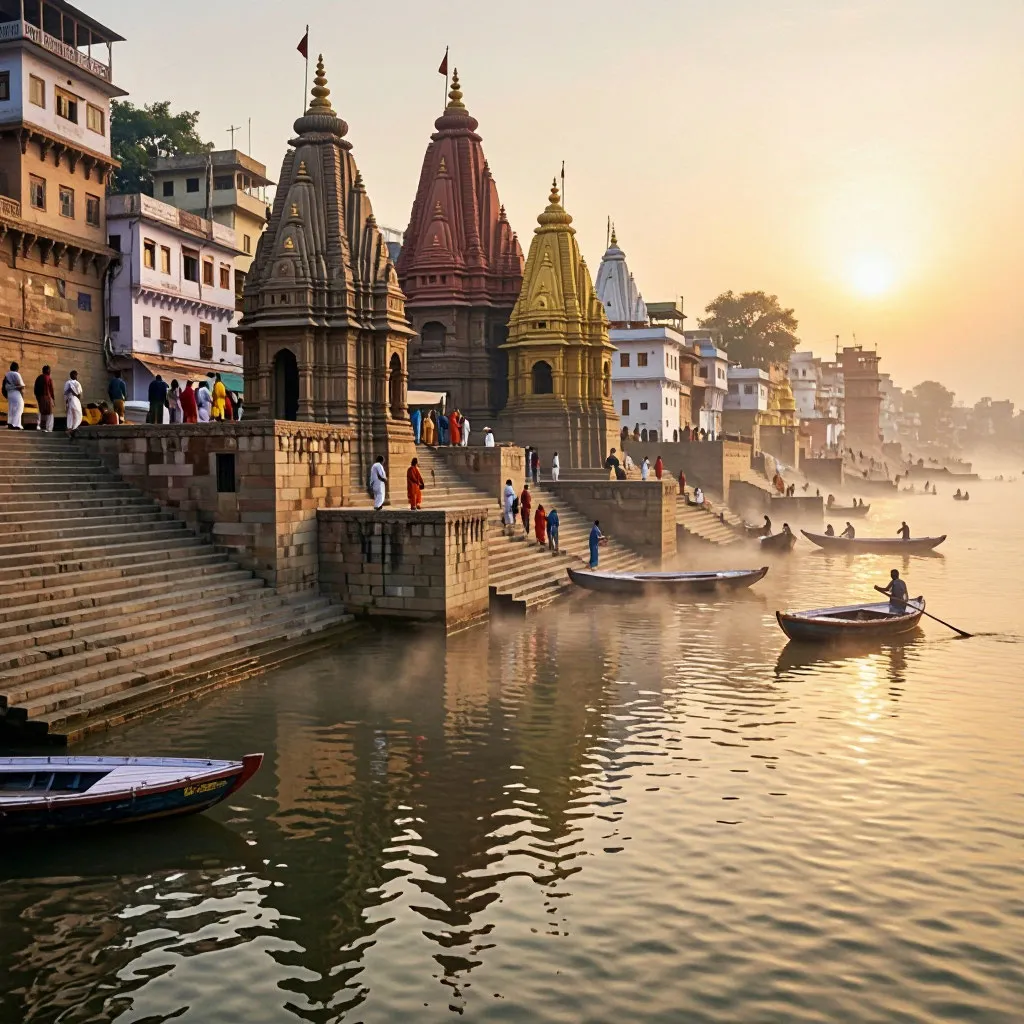
Varanasi does not ease you in. The moment you step out of the railway station or the airport, the air hits differently — a mixture of temple incense, marigold garlands, frying puris, and the faint, ever-present scent of the river. Cows wander through traffic with the confidence of pensioners. Cycle rickshaws weave through alleys so narrow that two people walking side by side would bump shoulders. Sadhus sit on corners with ash-smeared foreheads, and somewhere, always, a conch shell blows or a temple bell rings. This is not a city that performs for tourists. It is a city that exists in a rhythm older than most countries, and you are welcome to fall into step with it or get out of the way.
The trick to Varanasi is abandoning any expectation of order. The map is deceptive: two points that look 500 metres apart on Google Maps might require a fifteen-minute walk through a labyrinth of alleys where you will pass silk weavers, chai stalls, funeral processions, and a dozen shrines before reaching your destination. The riverfront is the spine of the city — 88 ghats stretching along the Ganges for about four kilometres — and everything of consequence radiates inward from there. Understanding the geography of the ghats is the first step to making sense of a place that can otherwise feel overwhelming.
When to visit and how many days you need
Varanasi experiences three distinct seasons that radically affect the travel experience. Winter (October to March) is the golden window: daytime temperatures hover between 15°C and 25°C, the river mist at dawn creates an ethereal atmosphere for boat rides, and outdoor activities are comfortable. Summer (April to June) is brutal, with temperatures regularly exceeding 42°C and hot dry winds (loo) that make daytime sightseeing inadvisable. The monsoon (July to September) brings heavy rains that flood the lower ghats, submerging several steps and narrowing the usable riverfront significantly.
For a first visit, three full days is the minimum that allows you to experience Varanasi without rushing. Day one should be spent walking the ghats and watching the Ganga Aarti at Dashashwamedh. Day two is for the temple circuit and Sarnath. Day three is for the narrower alleys, silk shops, a sunrise boat ride, and the parts of the riverfront you missed. Anything less than two full days risks reducing Varanasi to a checklist, which is precisely the wrong way to experience a city that rewards lingering.
The ghats of Varanasi: which ones matter and why
Each of Varanasi’s 88 ghats has a story, a function, and a character. Some are for prayer, some are for cremation, some are for washing clothes, and some are simply for sitting and watching the river. Walking the entire stretch from Assi Ghat in the south to Raj Ghat in the north takes about two hours at a leisurely pace, and it is the single best way to understand the city. You do not need to visit all 88 — but there are several that no traveller should miss.
Dashashwamedh Ghat is the spiritual epicentre and the site of the nightly Ganga Aarti, a choreographed fire ceremony that draws thousands of spectators. Manikarnika Ghat is the primary cremation ground, where bodies are burned openly on pyres along the river — a sight that shocks most first-time visitors but is profoundly sacred to Hindus. Assi Ghat is the southernmost ghat and the favourite of students, backpackers, and long-term travellers; it is quieter, cleaner, and hosts a morning subah-e-banaras programme with music and yoga. Harishchandra Ghat is the secondary cremation ghat, smaller and less crowded than Manikarnika. Man Mandir Ghat houses an 18th-century observatory built by Maharaja Jai Singh II of Jaipur, with astronomical instruments still visible on the rooftop. Panchganga Ghat marks the mythical confluence of five sacred rivers and is one of the oldest and most spiritually significant ghats, though it sees fewer tourists. Darbhanga Ghat is visually the most striking — its massive palace with a pair of stone lions at the water’s edge is one of the most photographed buildings on the riverfront.
Visitors should be aware of ghat etiquette. Photography is permitted at most ghats, but at Manikarnika and Harishchandra, photographing the cremation process is considered deeply disrespectful and should be avoided entirely. Dress modestly, remove shoes before entering any temple on the ghats, and be prepared for touts offering to guide you — a polite but firm refusal usually suffices.
The Ganga Aarti: timing, viewing spots and what to expect
The Ganga Aarti at Dashashwamedh Ghat is Varanasi’s most iconic experience. Held every evening at sunset (roughly 6:30 PM in summer and 5:30 PM in winter), it is a 45-minute ceremony in which seven young priests perform a synchronised ritual with large brass lamps, fire, conch shells, and incense, accompanied by chanting and live music. The crowd is dense — thousands of people pack the ghat steps, balconies of surrounding buildings, and boats on the river.
The best viewing options depend on your preference. Watching from the ghat steps is free and puts you close to the action, but you need to arrive at least 45 minutes early to find a good spot. Hiring a boat to watch from the water costs ₹200–₹500 per person depending on the season and negotiation, and offers a panoramic view of the ceremony with the entire ghat illuminated behind the priests. Several guesthouses and restaurants overlooking the ghat offer balcony viewing with food and drink service — expect to pay ₹300–₹800 for a table, but the elevated perspective and comfort are worth it for those who prefer not to sit on stone steps in a crowd.
Boat rides on the Ganges: sunrise, sunset and everything between
If there is one experience that defines Varanasi, it is the boat ride on the Ganges at dawn. The river is at its most beautiful in the first hour after sunrise, when the mist sits low on the water, the ghats glow gold in the early light, and the city is still half asleep. Pilgrims descend to bathe, washermen lay out their saris on the stone steps, and the first cremation pyres of the day begin to smoke at Manikarnika. A boat ride at this hour is not just sightseeing — it is a meditation on mortality, devotion, and the relentless continuity of human life along this river.
There are several types of boat rides available, each offering a different perspective on the city:
- Sunrise boat ride (5:30–7:00 AM): The most popular and most magical option. A one-hour rowboat ride from Assi Ghat to Manikarnika Ghat and back costs ₹200–₹400 per person if shared, or ₹800–₹1,500 for a private boat. The light is extraordinary, the crowds are thin, and the atmosphere is serene.
- Sunset boat ride (5:00–6:30 PM): Offers views of the ghats bathed in golden light, followed by the Ganga Aarti from the water. Prices are similar to sunrise rides, but the boat will anchor near Dashashwamedh for the ceremony.
- Full riverfront cruise (2–3 hours): Covers all 88 ghats from Assi to Raj Ghat, with the boatman explaining the significance of each. Costs ₹1,000–₹2,500 for a private boat. Best taken in winter when the sun is manageable.
- Evening flower ceremony boat ride: Includes a short puja ceremony on the boat with floating diyas (oil lamps). More touristy but visually stunning, especially with the Aarti in the background.
Regardless of which ride you choose, negotiate the price before boarding and clarify whether it is per person or per boat. Boatmen at Dashashwamedh and Assi ghats are accustomed to tourists and generally quote reasonable rates, but the gap between the initial asking price and the final agreed price can be significant.
Temples you cannot skip in Varanasi
Varanasi has over 2,000 temples, and it is neither possible nor desirable to visit them all. But several are architecturally, historically, or spiritually significant enough to warrant a visit, even if you are not on a pilgrimage. The temple circuit is best done in the early morning or late afternoon, when the alleys are less crowded and the heat is manageable.
Kashi Vishwanath Temple is the most sacred Shiva shrine in India and the spiritual heart of Varanasi. The current structure was built in 1780 by Ahilyabai Holkar, with a gold-plated spire added by Maharaja Ranjit Singh in 1835. The temple sits in a tightly packed zone with security checkpoints; mobile phones, cameras, bags, and leather items are not allowed inside. Expect long queues on weekends and festival days. Sankat Mochan Hanuman Temple, dedicated to Hanuman, is located near the Banaras Hindu University campus and was founded by the saint Tulsidas. It is one of the busiest temples in the city, especially on Tuesdays and Saturdays. Durga Temple, built in the 18th century in a North Indian nagara style with a red shikhara, is associated with a legend that the idol appeared on its own. The temple has a small water tank (kund) where devotees feed fish, considered sacred. Bharat Mata Temple, inaugurated by Mahatma Gandhi in 1936, is unusual: instead of deities, it houses a relief map of undivided India carved in marble on the floor. It is a quick but meaningful visit. New Vishwanath Temple, located inside the BHU campus, is a modern replica of the original with towering white marble spires and intricate carvings — less spiritually charged than the original but architecturally impressive and far less crowded.
For those willing to venture slightly outside the city, Sarnath — the site of Buddha’s first sermon — is a 30-minute drive and a profoundly peaceful contrast to the intensity of Varanasi. The Dhamek Stupa, the Ashoka Pillar, and the archaeological museum are the main attractions. Plan a half day for Sarnath and go in the morning to avoid the heat.
Where to stay: choosing the right area and hotel
The single most important accommodation decision in Varanasi is location. Staying near the ghats means you can walk to the riverfront, the temples, and the aarti without navigating traffic or haggling with rickshaw drivers. Staying outside the old city — in Cantonment or near the railway station — is cheaper and more comfortable but adds 20–30 minutes of travel time each way through some of India’s most congested streets.
The old city area around the ghats is the most atmospheric but also the most intense: narrow alleys, constant noise, cows, and a sensory overload that some travellers love and others find exhausting. Assi Ghat is the best base for first-timers — it is near the river but slightly removed from the densest crowds, has a good selection of guesthouses and cafes, and is the starting point for sunrise boat rides. Dashashwamedh area puts you at the centre of everything but also in the thickest crowds and noise. Shivala and Bhelupur are quieter residential neighbourhoods just south of the main ghats, with good mid-range options and less chaos. Cantonment and railway station area is the most practical for one-night stays or transit, with the widest range of budget and business hotels, but entirely lacks the character that makes Varanasi worth visiting.
Accommodation options by area and budget
Finding the right place to stay in Varanasi depends heavily on whether you prioritise atmosphere, convenience, or comfort. The old city offers the most authentic experience but the least conventional comfort; the Cantonment area offers the opposite. Within the old city, Assi Ghat has emerged as the preferred base for international travellers, with a cluster of guesthouses, rooftop cafes, and yoga centres within walking distance of the river.
| Area | Price range (per night) | Vibe | Best for | Drawbacks |
|---|---|---|---|---|
| Assi Ghat area | ₹800–₹4,000 | Backpacker-friendly, riverside, cafe culture | First-time visitors, solo travellers, long stays | Alleys can be confusing; limited parking |
| Dashashwamedh area | ₹600–₹3,500 | Intense, central, loud | Pilgrims, those who want to be at the heart of everything | Very crowded, noisy, narrow lanes, no vehicle access |
| Shivala / Bhelupur | ₹1,200–₹6,000 | Quieter residential, green | Families, couples, those who prefer calm | 15-minute walk to main ghats |
| Cantonment / Lanka | ₹1,500–₹8,000 | Modern, spacious, hotel-style | Business travellers, short stays, those with vehicles | 20–30 minutes from ghats by rickshaw |
| Palace guesthouses (riverside) | ₹5,000–₹25,000 | Heritage, luxurious, panoramic river views | Luxury travellers, special occasions | Expensive, limited availability, advance booking essential |
The trade-off is clear: proximity to the ghats comes at the cost of space, quiet, and conventional hotel amenities. For a two-to-three-day visit, staying near the ghats is almost always the right call — the time saved and the immersive experience are worth the compromises. For longer stays or for travellers who need modern facilities, the Cantonment or Shivala areas offer a better balance.
Eating in Varanasi: where the food is part of the pilgrimage
Varanasi’s food culture is inseparable from its spiritual identity. This is a city where breakfast means kachori-sabzi at a shop that has been frying the same recipe for 150 years, where the best lassi comes in clay cups handed to you by a man whose family has been making it for four generations, and where the concept of “fine dining” is irrelevant compared to the perfection of a single, perfectly fried tamatar chaat.
The culinary landmarks are scattered through the old city and require a willingness to sit on plastic stools, eat with your hands, and accept that the best food in Varanasi comes from shops the size of a closet. Kashi Chat Bhandar near Godowlia serves the famous tamatar chaat — a tangy, spiced tomato curry over crispy fried dough that has no equivalent anywhere else in India. Deena Chaat Bhandar is another chaat institution, with a broader menu and a constant queue. Pehalwan Lassi at Raja Ghat makes thick, creamy lassi in a hand-churned style that has not changed in decades. The Blue Lassi near Kashi Vishwanath Temple is the most famous lassi shop among travellers, with dozens of flavours and a theatrical preparation style — mango in season, pomegranate, apple, and the classic plain sweet lassi. Kachori Sabzi at Ram Bhandar or at Thatheri Bazaar is a breakfast essential — fried kachoris served with a spicy potato curry, eaten before 10 AM while the oil is fresh. For sit-down meals, Brown Bread Bakery near Assi Ghat offers organic vegetarian food and rooftop seating; Kerala Cafe serves South Indian thalis; and for a splurge, the rooftop restaurant at the Palace on the Ganges serves traditional Awadhi cuisine with a view of the river.
Practical tips for navigating Varanasi
Varanasi rewards preparation. The city’s infrastructure is not designed for tourist convenience, and a few practical decisions made in advance can save hours of frustration and prevent the kind of exhaustion that turns a magical visit into an ordeal.
Here is what experienced travellers recommend:
- Carry cash. Most chai stalls, street food vendors, boatmen, and small shops do not accept digital payments. ATMs exist in the old city but are frequently out of cash. Withdraw enough at the airport or railway station.
- Wear comfortable shoes you can remove easily. You will enter multiple temples and some ghats where shoes must be left at the entrance. Slip-on shoes or sandals are far more practical than lace-up boots.
- Hire a local guide for the temple circuit. The alleys are labyrinthine, and the stories behind each temple and ghat are not self-evident. A licensed guide costs ₹500–₹1,500 for a half day and adds enormous depth.
- Do not drink the Ganges water. Despite its sacred status, the river is heavily polluted with sewage and industrial waste. Bathe if your faith requires it, but keep your mouth closed and do not ingest the water.
- Carry a power bank. Power cuts are common in the old city, and finding a charging point in a guesthouse alley is not always straightforward.
- Be prepared for the cremation ghats. Seeing a body being burned openly is confronting for most visitors. You are watching a family’s most private moment. Walk past quietly, do not photograph, and do not loiter as a spectacle-seeker.
Following these practical guidelines does not guarantee a smooth trip — Varanasi is never entirely smooth — but it does ensure that you spend your time absorbing the city rather than fighting its logistics. The travellers who fall in love with Varanasi are rarely the ones who had the most comfortable stay; they are the ones who let the city be what it is, mess and all, and discovered that the chaos has a rhythm, the noise has a melody, and the river holds everything together with a patience that puts every human timeline into perspective.