
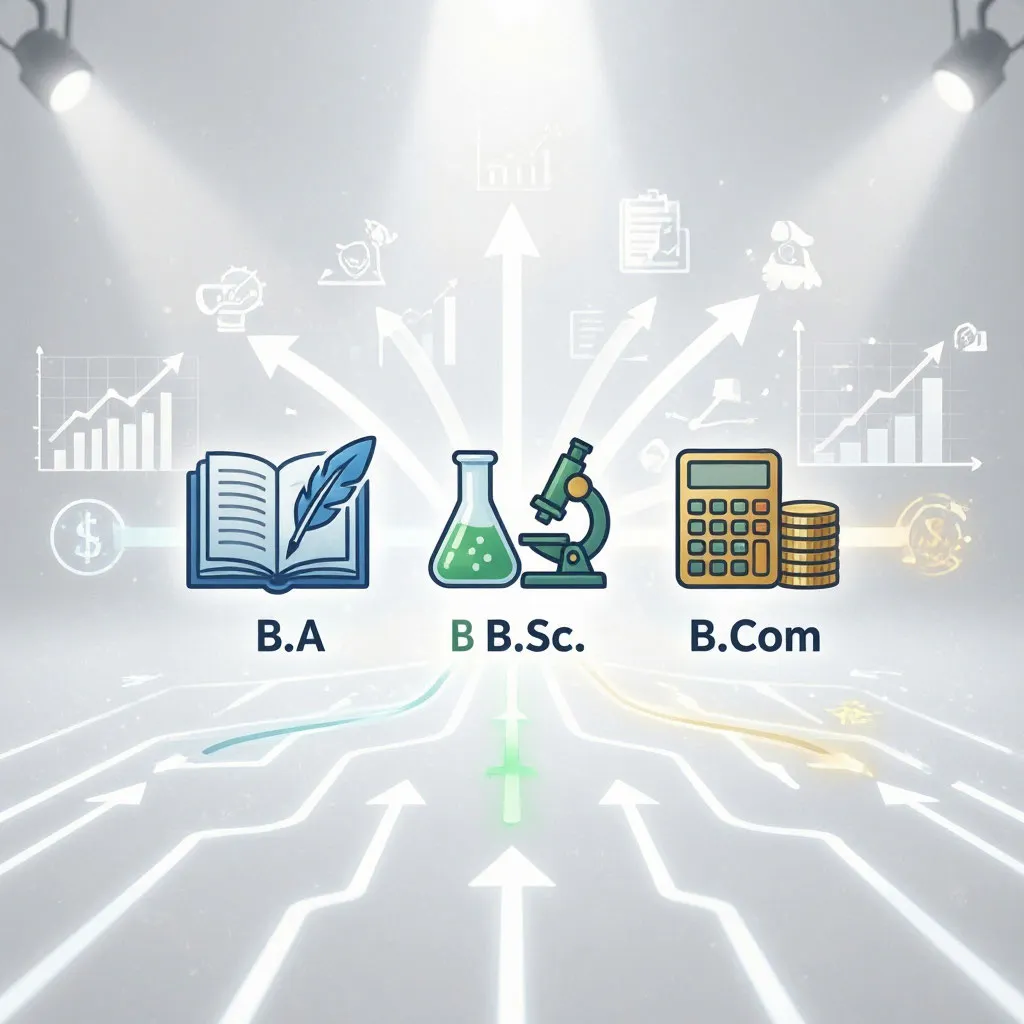
Most students finishing class 12 treat the choice of undergraduate degree as a paperwork decision — something to fill in on a form before the admission deadline. In reality, it is one of the few choices made at age eighteen that genuinely shapes the trajectory of an entire career. Not because the degree itself is irreversible — plenty of engineers become writers and plenty of history graduates become investment bankers — but because the three years you spend studying a subject determine the skills you build, the network you form, the internships you land, and the doors that open automatically versus the ones you have to force.
The Indian higher education system offers dozens of undergraduate options, but three degrees dominate the landscape: Bachelor of Arts (B.A.), Bachelor of Science (B.Sc.), and Bachelor of Commerce (B.Com). Each represents a fundamentally different approach to learning, a distinct skill set, and a separate employment ecosystem. Choosing between them is not about prestige or what your neighbour’s child did. It is about matching your aptitude, interests and financial expectations to a path that gives you the best chance of building a career you actually want.
Understanding what each degree actually teaches you
Before comparing outcomes, it helps to understand what these three degrees contain at their core. They are not just labels — they represent different ways of thinking, different modes of assessment, and different relationships with the job market.
A B.A. is the broadest of the three. It covers humanities and social sciences: English, political science, history, sociology, psychology, economics (in some universities), philosophy, geography and languages. The pedagogy is reading-intensive, writing-driven and discussion-based. You learn to analyse texts, construct arguments, understand human behaviour and communicate ideas — skills that do not map to a single job title but are transferable across dozens of industries. A B.A. rewards curiosity, verbal ability and critical thinking. It is also the degree most likely to require postgraduate study for career advancement, because undergraduate-level humanities qualifications alone rarely command premium salaries.
A B.Sc. is the most specialised. It covers pure and applied sciences: physics, chemistry, mathematics, biology, computer science, statistics, biotechnology, environmental science and electronics. The pedagogy is lab-based, quantitative and exam-driven. You learn to work with data, follow scientific methodology, solve structured problems and think analytically. A B.Sc. builds hard skills that map directly to technical roles in research, technology, healthcare and data-driven industries. It is the degree most likely to lead directly into employment without requiring a master’s, though postgraduate study significantly increases earning potential in scientific fields.
A B.Com. sits between the two. It covers accounting, business law, economics, taxation, finance, marketing and management. The pedagogy blends quantitative methods with business communication and regulatory knowledge. You learn to read financial statements, understand tax structures, analyse business performance and navigate the regulatory environment. A B.Com. is the most directly vocational of the three — its syllabus is designed to feed into specific professional certifications like CA, CMA, CS, CFA and MBA, all of which dramatically increase earning power.
Career paths each degree opens up
The career options available after each degree are broader than most students realise, but they differ in nature. A B.A. opens doors that require communication and analytical thinking. A B.Sc. opens doors that require technical expertise. A B.Com. opens doors that require financial literacy and business understanding.
Let us look at the specific career routes each degree typically leads to:
- B.A. career paths: Civil services (IAS, IPS, IFS through UPSC), journalism and media, content writing and editing, public relations, social work, teaching and academia, human resources, policy research, NGO and development sector roles, advertising, foreign language specialist, archaeology, counselling. Many of these roles require or benefit from postgraduate qualifications — a master’s degree, a B.Ed. for teaching, or a law degree (LLB) for legal careers.
- B.Sc. career paths: Research scientist, data analyst, software developer (for B.Sc. in computer science or IT), biotechnologist, medical laboratory technologist, environmental consultant, pharmaceutical researcher, quality control analyst, statistician, forensic scientist, agricultural scientist. Professional certifications like clinical research diplomas or a master’s in data science can significantly boost earnings.
- B.Com. career paths: Chartered Accountant (CA), Company Secretary (CS), Cost and Management Accountant (CMA), financial analyst, investment banking associate, tax consultant, auditor, banking officer, insurance underwriter, stockbroker, business consultant, entrepreneur. The most lucrative B.Com. career paths almost always involve additional professional certification alongside the degree.
The range of options after each degree is wide, but the earning potential and growth trajectory vary significantly. A B.A. graduate entering civil services may start with a modest salary but can reach the highest pay brackets in government employment. A B.Com. graduate who completes CA can earn more in the first year of practice than many master’s degree holders. A B.Sc. graduate who moves into data science or software can command salaries that rival engineering graduates within a few years of work experience.
Salary expectations: what graduates actually earn
Salary data for Indian graduates is notoriously fragmented, with enormous variation depending on the institution, the city, the industry and the individual’s additional qualifications. But certain patterns are consistent enough to guide decision-making. The figures that follow represent typical ranges for fresh graduates and mid-career professionals based on recent industry reports and recruitment data from major Indian metros.
| Degree | Starting salary (fresher) | Mid-career salary (5-8 years) | Top-tier potential (10+ years) | Key salary multiplier |
|---|---|---|---|---|
| B.A. (general) | ₹2.5–4.5 LPA | ₹5–9 LPA | ₹12–20 LPA | Postgraduate degree, civil services |
| B.A. (economics, top college) | ₹5–8 LPA | ₹12–18 LPA | ₹25–40 LPA | Master’s, consulting, policy |
| B.Sc. (general) | ₹3–5 LPA | ₹6–10 LPA | ₹12–18 LPA | M.Sc., research fellowships |
| B.Sc. (computer science/data) | ₹4–7 LPA | ₹10–16 LPA | ₹20–35 LPA | Certifications, M.Tech, experience |
| B.Com. (general) | ₹2.5–4 LPA | ₹5–8 LPA | ₹10–15 LPA | CA, CMA, CFA, MBA |
| B.Com. + CA | ₹6–10 LPA | ₹12–20 LPA | ₹25–50+ LPA | Practice, senior corporate roles |
The data reveals something important: the degree alone does not determine earning power — the combination of degree plus additional qualification does. A general B.A. graduate earns modestly, but a B.A. economics graduate from a top college who pursues a master’s can match or exceed B.Com. graduates. Similarly, a B.Sc. in computer science can out-earn a B.Com. graduate, but a B.Com. graduate who completes CA can out-earn almost everyone. The salary column that matters most is the last one: the key salary multiplier. That column shows what truly drives earnings upward after each degree, and planning for that multiplier from day one is what separates graduates who build lucrative careers from those who stagnate.
Factors to consider beyond salary and job titles
Salary figures and career lists are necessary but insufficient. A career is not just a payslip — it is forty years of daily work, and choosing a path that pays well but makes you miserable is not a sustainable strategy. Several non-financial factors deserve serious consideration before committing to a degree.
Your natural aptitude matters more than your current marks. A student who scores 90% in mathematics but finds problem-solving tedious and draining will not thrive in a B.Sc. physics programme, regardless of how good the numbers look on paper. Conversely, a student who scores 75% but reads voraciously, writes fluently and thinks critically about social issues may excel in a B.A. political science programme and build a far more fulfilling career than the higher-scoring peer who chose science under pressure.
The job market trajectory of each field deserves attention. Automation is reshaping entry-level accounting and bookkeeping tasks that traditionally absorbed B.Com. graduates, which means a plain B.Com. without professional certification is becoming less valuable over time. Meanwhile, data-driven decision-making is creating demand for graduates who can combine quantitative skills with domain knowledge — a space where B.Sc. graduates with coding skills and B.A. economics graduates with statistical training both compete. Understanding which skills are becoming more valuable and which are being commoditised helps you position yourself ahead of the curve rather than behind it.
How to decide when you are genuinely torn
Many students find themselves interested in two or even all three paths and struggle to pick one. This is normal, and there are practical strategies to resolve the uncertainty without gambling three years of your life on a coin flip.
A useful approach is the “day-in-the-life” test. Instead of imagining the degree, imagine the daily work it leads to. A B.Sc. chemistry graduate spends their early career in laboratories, running tests and writing reports. A B.A. journalism graduate spends it chasing stories, interviewing people and writing under deadlines. A B.Com. graduate preparing for CA spends it poring over ledgers, tax returns and audit files. Ask yourself honestly which of those daily realities you find more bearable — or even enjoyable. The degree is three years; the work is decades.
Consider the following strategies to make a confident choice:
- Shadow a professional for a day: If you know anyone working in a field you are considering — a journalist, a chartered accountant, a research scientist — ask to spend a day with them. Observing the actual work, not the idea of the work, clarifies more than any brochure.
- Take a free online course in the subject: Spend two weeks on a free Coursera or edX module in the subject area of each degree you are considering. If you find the B.Sc. physics module fascinating and the B.Com. accounting module tedious, that is real signal, not speculation.
- Check the placement data of specific colleges: Generic career prospects matter less than the specific outcomes at the college you can actually get into. A B.A. from St. Stephen’s or Hindu College opens doors that a B.A. from a lesser-known institution does not. Placement records, alumni networks and faculty quality vary enormously between colleges and can be more important than the degree itself.
- Plan for the multiplier from the start: If you choose B.Com., start CA foundation alongside. If you choose B.Sc. computer science, begin coding and internship hunting in your first year. If you choose B.A. economics, plan your master’s application strategy by the second year. Treating the degree as step one of a multi-step plan — rather than an end in itself — changes how you use those three years.
- Talk to people who switched paths: Find someone who did a B.A. and moved into business, or someone who did a B.Sc. and became a writer. Understanding how transferable each degree is in practice will reduce the anxiety of making the “wrong” choice.
The students who build the most successful careers are rarely the ones who chose the “best” degree — they are the ones who used their chosen degree deliberately, treated the three years as a foundation rather than a destination, and planned their next steps while still in college. A B.A. graduate who spent three years writing, interning and networking enters the job market far better prepared than a B.Sc. graduate who merely attended lectures and passed exams.
The role of postgraduate study and professional certification
For all three degrees, the undergraduate qualification is increasingly the base layer rather than the finished product. The Indian job market has become fiercely competitive, and a standalone bachelor’s degree — regardless of stream — rarely commands a premium salary without additional qualifications. Understanding what comes after the degree is therefore essential to choosing the right degree in the first place.
For B.A. graduates, the most common progression is a master’s in the same or a related subject, followed by either academic careers (teaching, research) or professional pivots. A B.A. in English followed by a master’s in journalism, a B.A. in political science followed by a law degree, or a B.A. in economics followed by a master’s in public policy — these combinations create graduates with both breadth and specialisation, a combination that employers value more than narrow specialisation at the undergraduate level.
For B.Sc. graduates, the path often splits between research and industry. Those pursuing research typically complete an M.Sc. and then a PhD, eventually moving into academic or industrial research positions. Those moving into industry may supplement their B.Sc. with a professional diploma or certification — a data science bootcamp, a clinical research certificate, a software development course — to bridge the gap between academic knowledge and industry-ready skills. B.Sc. computer science graduates are the exception: they often enter the workforce directly, as their skills are immediately applicable.
For B.Com. graduates, the professional certification path is not optional — it is the main event. The B.Com. degree provides the knowledge base, but the CA, CMA, CS, CFA or MBA qualification provides the market value. Students who enrol in B.Com. without a plan to pursue at least one of these certifications are often disappointed by the salary outcomes, because the B.Com. alone competes in a crowded entry-level market where employers expect more.
Common mistakes students make when choosing their degree
The decision-making process around undergraduate degrees in India is fraught with social pressure, misinformation and emotional reasoning. Recognising the most common pitfalls can save years of wasted effort and regret.
The single most damaging mistake is choosing a degree based on family expectation rather than personal aptitude. Countless students enrol in B.Sc. because “science is superior” or in B.Com. because “commerce has jobs” — not because they have any genuine interest in the subject. The result is three years of disengaged studying, mediocre grades, and a degree that opens no doors because the graduate has neither passion nor competence in the field. Indian employers are increasingly skill-focused, and a passionate B.A. graduate with strong communication and writing abilities is far more employable than a disinterested B.Sc. graduate who scraped through exams.
Another frequent error is overvaluing the degree and undervaluing the college. A B.Com. from a Tier-3 college with poor faculty, no placement support and a weak alumni network delivers far less career value than a B.A. from a well-known college with active placement cells, guest lectures, internship partnerships and a brand name that opens doors. When the choice is between a less-preferred degree at a better college and a more-preferred degree at a weaker college, the better college frequently wins — because the network, exposure and signalling value of the institution often outweigh the subject studied.
A third mistake is ignoring the financial reality of postgraduate study. If you choose B.A. knowing that a master’s degree is essential for a good career but your family cannot fund two more years of study, you may find yourself stuck with an undergraduate qualification that limits your options. Conversely, if you choose B.Com. and plan to pursue CA, you should know that the CA qualification takes an average of four to five years to complete, with a pass rate of around 10-15% per attempt. Planning your degree choice without planning how you will fund and complete the next steps is a recipe for frustration.
Making peace with your choice
No undergraduate degree is a mistake if you approach it with intention. The B.A. graduate who writes brilliantly, thinks critically and communicates clearly will always find opportunities. The B.Sc. graduate who develops technical depth and stays current with industry tools will remain in demand. The B.Com. graduate who pairs the degree with a professional certification and builds financial expertise will command premium salaries. The degree you choose matters less than what you do with it — but choosing a degree that aligns with your strengths, interests and realistic career expectations gives you a head start that compounds over a lifetime. The right choice is not the one that impresses your relatives; it is the one that makes the next three years feel like the beginning of something you genuinely want to build.