
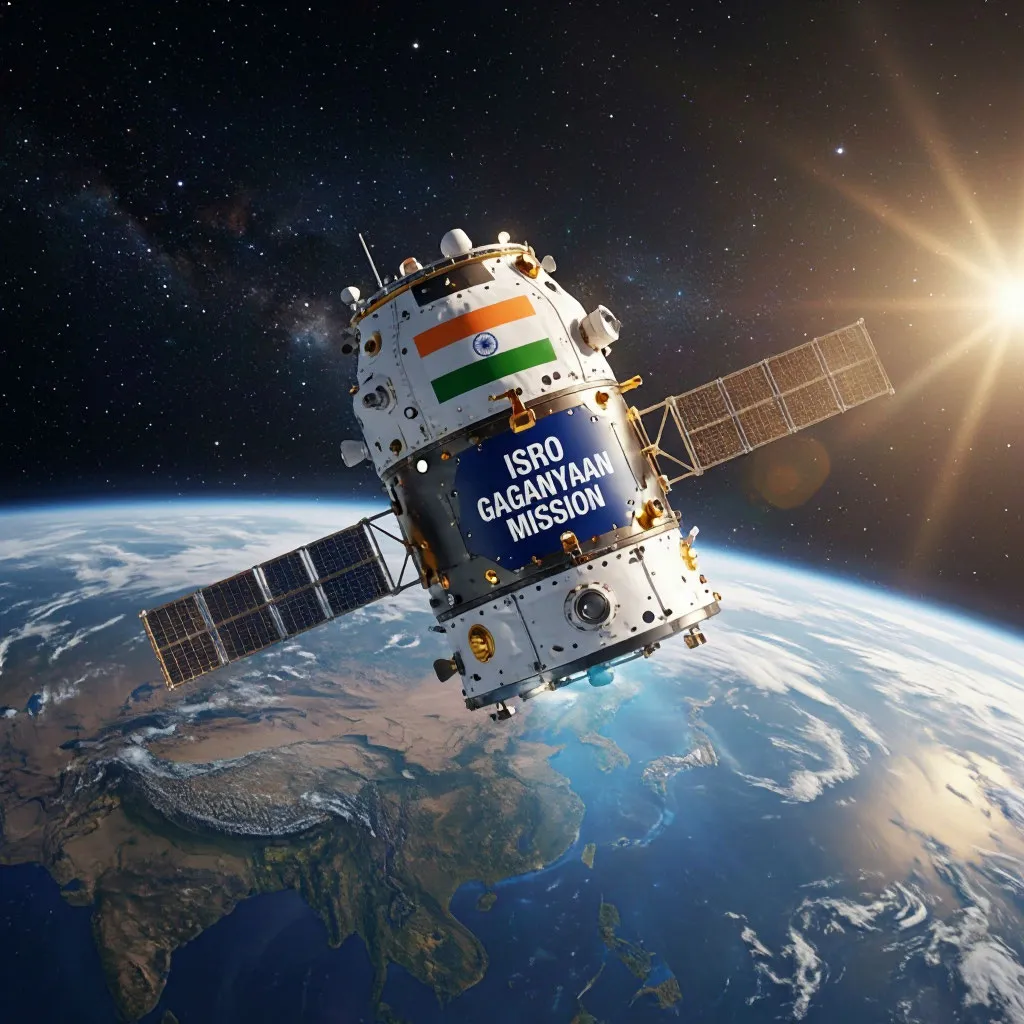
For decades, the silent expanse of the cosmos has been navigated by a select club of nations. Now, India is poised to break into this exclusive circle with its most ambitious technological endeavor yet. By sending humans into Earth’s orbit and bringing them back safely, the Indian Space Research Organisation is demonstrating that space exploration is no longer reserved for historical superpowers. This monumental leap not only showcases technological self-reliance but also captures the collective imagination of a nation looking toward the stars.
The core objectives of the historic voyage
To understand the true scale of this undertaking, one must look at the specific scientific and engineering milestones the Indian Space Research Organisation aims to achieve. The primary goal goes far beyond simply placing citizens in orbit; it involves establishing a sustainable ecosystem for future off-world endeavors.
- Orbital placement: launching a crew module into a low Earth orbit of about four hundred kilometers for a multi-day mission.
- Safe recovery: executing a precise re-entry maneuver and securing a safe splashdown in the Indian Ocean.
- Life support systems: deploying domestically designed environmental control networks to keep the crew comfortable in space.
- Scientific research: performing a series of microgravity experiments to advance materials science and biotechnology.
By masterfully executing these individual phases, India will join an elite group of only three countries that have independently launched humans into space. Success here serves as a vital stepping stone for more complex initiatives, including a planned indigenous space station and eventual lunar exploration.
Meet the Gaganyatris: training India’s space pioneers
The heart of the India manned space mission lies in the rigorous physical and mental preparation of the candidates chosen from the Indian Air Force. Known locally as Gaganyatris, these pioneers have undergone exhausting training programs both domestically and internationally to prepare their bodies for the extreme forces of spaceflight.
The extensive training program of the Indian astronauts ISRO has selected ensures they are ready for the extreme challenges of the upper atmosphere.
| Training module | Primary location | Focus area |
|---|---|---|
| Basic spaceflight theory | Star City, Russia | centrifuge training, G-force tolerance, and survival skills |
| Crew module familiarization | Bengaluru, India | simulator training, interface navigation, and emergency drills |
| Physical conditioning | multiple facilities | cardiovascular health, yoga, and weightless state preparation |
| Recovery procedures | Indian Navy yards | open-water sea survival and post-landing egress operations |
This comprehensive curriculum ensures that the crew members can handle both the physiological toll of rapid acceleration and any unexpected system malfunctions. The combination of international expertise and local survival training creates a highly resilient team capable of executing their tasks under intense pressure.
The stepping stones: unmanned test flights
Before any human climbs aboard the launch vehicle, a series of unmanned preparatory missions must validate every safety system to a fraction of a percent. These preliminary flights use specialized test vehicles and humanoid robots to gather crucial data on how the spacecraft performs under actual launch conditions.
- Integrated air drop test: verifying the deployment and stability of the main parachute systems at high altitudes.
- Test vehicle abort missions: demonstrating the quick-escape systems that pull the crew module away from the rocket in an emergency.
- Vyommitra robotic flight: sending a highly advanced, female-looking humanoid robot into orbit to monitor cabin parameters.
- Full unmanned orbital trial: executing a complete simulated mission from launch to ocean recovery without a crew.
Each successful phase brings the actual Gaganyaan launch date closer to reality, giving flight controllers the confidence needed for a crewed attempt. These progressive steps minimize the risks, ensuring that when the human crew finally boards, every component has been tested in simulated environments.
Establishing India as an elite space superpower
The success of the ISRO Gaganyaan mission will permanently alter the global geopolitical and scientific landscape. It signals that India is no longer just a budget-friendly satellite launcher, but a mature spacefaring nation capable of executing the most complex engineering feats known to humanity. As the countdowns approach, the nation watches with anticipation, knowing that the footsteps of these astronauts will pave a path for generations of future scientists and dreamers.