Few school decisions cause as much parental anxiety as the choice of education board. Relatives offer strong opinions, school principals offer stronger ones, and somewhere in the middle sits your child, who will actually live with the decision for years. The truth that rarely makes it into these debates is that no board is universally “better” — each is built around a different idea of what school should feel like, and the right answer depends on your child’s temperament, your family’s mobility and your long-term plans. This comparison walks through how the three major options actually differ, well beyond the syllabus myths, so the choice becomes an informed one rather than a herd one.
Understanding the three boards at a glance
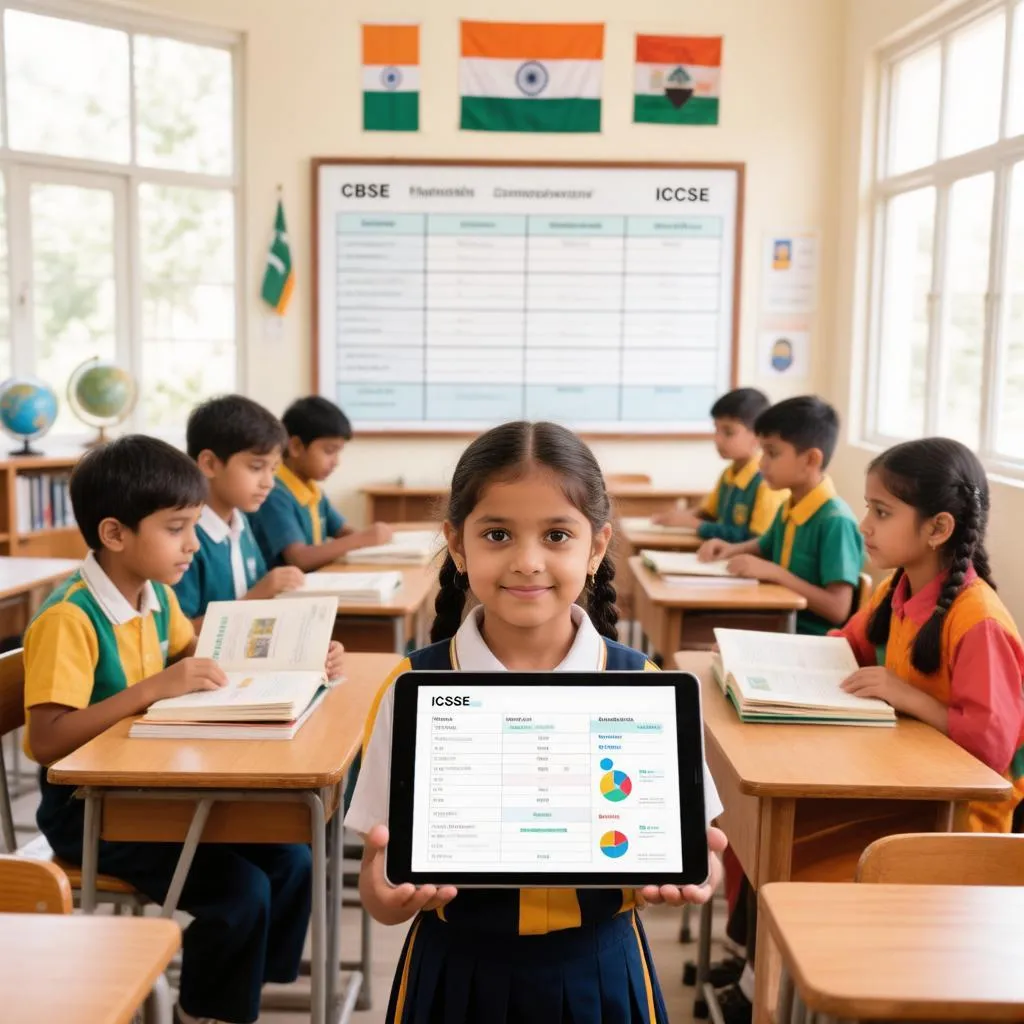
Before comparing depth, it helps to know who runs what. CBSE (Central Board of Secondary Education) is a national board governed by the Government of India, followed by the largest number of schools across the country and abroad. ICSE (Indian Certificate of Secondary Education) is administered by the Council for the Indian School Certificate Examinations, a private, non-governmental board known for a broad, English-heavy curriculum. State boards are run by each state’s own education department, with syllabi, exam patterns and languages designed around that state’s context.
Parents often treat this as a three-way fight, but the boards are not really competing for the same goal. CBSE prioritises a streamlined, exam-aligned structure that maps closely onto national entrance examinations. ICSE spreads wider, balancing languages, arts, sciences and applied projects. State boards anchor themselves in regional language, local content and affordability. Once you see the design intent, the question shifts from “which is best” to “which best matches my child”.
How the three boards differ in everyday learning
Syllabus documents matter less than what a school day actually feels like, and this is where the boards diverge most noticeably. CBSE tends to move briskly through physics, chemistry, mathematics and biology with a strong conceptual spine and comparatively less project work at the junior levels. ICSE assigns significant weight to English literature and language, includes creative and applied subjects, and asks students for internal projects and practical assignments across more subjects. State boards vary enormously from one state to another — some have modernised aggressively with activity-based learning, while others remain more exam-oriented and lecture-driven.
The teaching style in the classroom often follows the board’s assessment philosophy. Where exams reward applied understanding, teachers lean on experiments, presentations and discussion; where exams reward precise written answers, revision and practice dominate. This is why the same board can produce noticeably different experiences in two cities — the board sets the frame, but the school fills it.
Comparing the boards on the factors that matter
Framing the differences side by side makes the trade-offs clearer than any single argument can. The overview below captures how each board typically behaves on the criteria parents weigh most often.
| Factor | CBSE | ICSE | State boards |
|---|---|---|---|
| Curriculum breadth | Focused, science and maths oriented | Broad, with strong English and arts balance | Varies by state, often exam centred |
| Language emphasis | English and Hindi instruction | English medium, heavy on language skills | Frequently bilingual or regional language |
| Alignment with national entrance exams | Very high, syllabus overlaps directly | Moderate, requires extra targeted preparation | Moderate, varies by state syllabus updates |
| Assessment style | Structured exams, objective sections | Mix of exams, projects and internal assessment | Largely exam based, evolving in several states |
| School availability | Very high across India and abroad | Concentrated in cities and larger towns | Very high within the state, rare outside |
| Fee levels | Mid to high, school dependent | Generally the highest of the three | Usually the most affordable |
| Transfer ease | Simple across India | Moderate, fewer schools everywhere | Transfers outside the state often need equivalence |
Two patterns stand out from the rows above. First, CBSE’s real advantage is mobility and exam alignment rather than any inherent academic superiority. Second, ICSE’s breadth builds strong language and analytical habits, but it demands more sustained effort across subjects, which suits some children and exhausts others. State boards, meanwhile, are not a monolith — Karnataka’s syllabus and Tamil Nadu’s syllabus share a label but little else, so any state board decision deserves its own local research.
Signs that point to the right board for your child
Because “better” depends on the child, the most useful exercise is matching board traits to your child’s actual behaviour rather than to generic rankings. Consider these signals:
- Your child learns comfortably through reading and writing in English and enjoys literature, discussion and projects — this combination thrives under ICSE’s breadth.
- Your child is aiming for engineering or medical entrance examinations and prefers a clear, structured path — CBSE’s syllabus alignment gives a genuine head start.
- Your family may relocate between states or abroad during school years — CBSE’s nationwide footprint makes transfers almost seamless.
- Your child is more comfortable in your regional language, or the family wants schooling rooted in local context — a good state board school can serve this better than any national board.
- Your child struggles under exam pressure but excels at coursework — boards with substantial internal assessment reduce single-exam dependence.
- Budget is a deciding factor — state board schools and several good CBSE institutions keep fees accessible while quality varies school by school.
Notice that none of these signals says anything about how “smart” a child is; they describe temperament, goals and circumstances. A bright child can flourish under any board, and a struggling child can be failed by any board if the school itself is weak — which brings up the factor that matters more than the board name.
The school often matters more than the board
Parents frequently agonise over the board while settling quickly on the school, yet the daily influence on a child comes from teachers, class size, discipline culture and peer group — all properties of the school, not the syllabus. A well-run CBSE school with invested teachers will outperform a careless ICSE school in every measurable way, including board results. Before finalising the board, spend time on the school’s actual quality: talk to parents of current students, look at how the school handles struggling learners, check teacher turnover if you can, and visit the campus on a working day rather than an open house.
It is also worth examining how a school implements its board. Some CBSE schools add enrichment beyond the syllabus; some ICSE schools quietly compress the project work their board prescribes. The label tells you the framework; the school tells you the reality.
How each board shapes the road after Class 12
The board decision ripples forward, so it deserves an honest look at what happens after the final exam. For students targeting national entrance tests such as those for engineering and medicine, CBSE’s syllabus overlap reduces the burden of parallel preparation, which is a real, practical advantage. ICSE students often carry stronger written English and analytical grounding into college, which pays off in competitive exams with descriptive components, law aptitude tests, humanities degrees and study abroad, though they typically invest extra hours aligning with national entrance syllabi. State board students can and do crack every entrance examination — lakhs have — but preparation strategy matters more, since the syllabus may sit a step away from the national test pattern in some states.
College admissions themselves treat all recognised boards equally, with normalisation where needed, so no board carries a stain. What differs is preparation effort, not eligibility.
Common myths worth setting straight
The board debate generates a reliable crop of half-truths, and clearing them removes a lot of needless guilt and panic. Keep these in mind as you weigh your options:
- “State boards are easier, so their students are behind.” Difficulty varies wildly by state and school, and board rigour is not a reliable predictor of a child’s growth.
- “ICSE guarantees better English.” It helps, but a child who reads widely at home under any board usually outpaces a reluctant reader in the same classroom.
- “CBSE is only good for entrance exams.” Its streamlined approach also reduces pressure for children who are not exam-oriented, freeing time for sports and other pursuits.
- “Switching boards mid-school is a disaster.” Transfers are routine and well-supported, especially into CBSE, though equivalence paperwork may be needed when crossing into a different state board.
The healthiest takeaway from these myths is that the board is one input among many. Reading habits, sleep, parental engagement and the quality of teaching around a child shape outcomes far more decisively than the acronym on the certificate.
A practical way to make the final decision
Once the research is done, a simple decision structure keeps the choice grounded. Start with your child: list their strengths, subjects they enjoy and how they respond to pressure. Add your constraints: budget, likely relocations within the next few years, and the schools genuinely accessible from home. Then map the shortlisted schools against the board that fits — and resist the temptation to chase a board name into a long commute or a strained budget, because both quietly erode everything a good syllabus promises.
Whatever you choose, revisit the decision at natural milestones rather than in a panic after one exam result. Boards can be changed at defined transitions, children develop in ways no kindergarten interview predicted, and the most valuable thing a school decision can buy is not a certificate label but a child who still likes learning when the school day ends.