
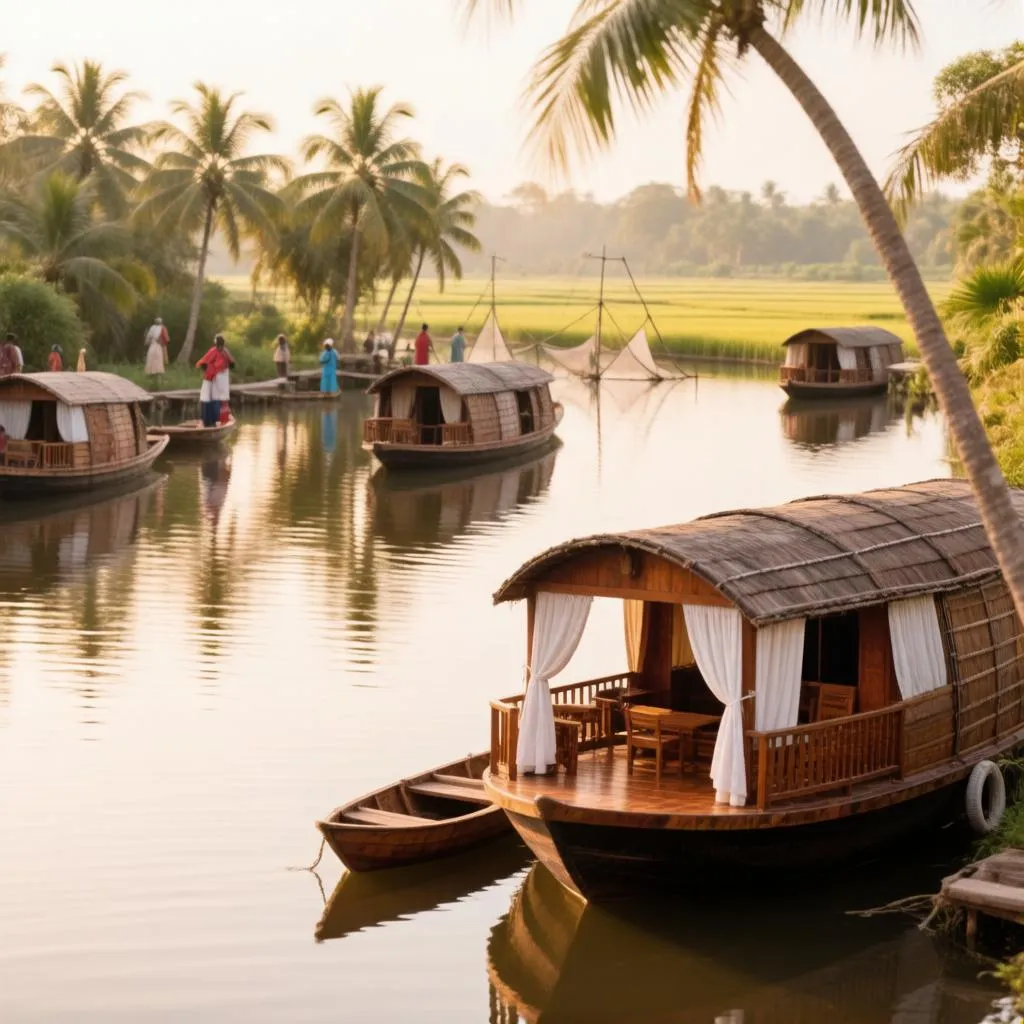
There is a moment on every Alleppey houseboat when the engine drops to a murmur, the palm shadows slide across the deck and the only sound left is water moving against the hull — and that moment is the reason people travel across the world for the Kerala backwaters. This maze of lagoons, canals and rivers stretching roughly 900 kilometres along the Malabar coast is not one attraction but a slow, floating way of seeing village India: rice paddies below sea level, toddy tappers on bamboo stilts, churches and mosques sharing shorelines, and kingfishers flashing turquoise between the reeds. Getting it right, though, takes more than booking the first houseboat a search engine offers. The season changes everything, the boat categories are wildly unequal, and the best moments of the region lie beyond the standard cruise loop. This guide walks through all of it, ending with a three-day itinerary that has stood the test of many trips.
Understanding the backwaters: more than Alleppey
Alleppey — officially Alappuzha — is the launch pad, but the backwaters form a connected system where the best experiences come from moving between bases rather than staying in one town. The Vembanad Lake anchors the network, India’s longest lake, feeding into canals that thread between Kollam in the south and Kochi in the north, with side branches to Kumarakom’s bird sanctuary and the quiet reaches of Kayamkulam. Each hub has a distinct personality: Alleppey is the houseboat capital with the most operators and the busiest channels, Kumarakom offers resort-style luxury on the lake’s eastern shore, and Kollam, linked to Alleppey by the legendary eight-hour Ashtamudi cruise, remains the under-visited southern gateway.
The mistake most first-timers make is treating the houseboat as the whole trip. It is the highlight, but a night on the water works best bookended by shore time — a heritage homestay in Fort Kochi, a canoe ride through the narrower Kainakary canals, or a morning at Marari’s fishing beach. The backwaters reward the traveller who mixes the floating and the grounded.
Choosing the right season
Kerala’s weather splits the year into three distinct travel experiences, and picking the wrong window can turn a dream cruise into a humid endurance test. The differences matter more here than in most Indian destinations because the entire appeal — open decks, sunset cruises, early-morning birdlife — depends on being outdoors:
- November to February (peak season). Cool, dry and clear, with daytime temperatures between 23 and 30 degrees. This is the ideal window for houseboats and canoe trips, and also the busiest: book boats and rooms four to six weeks ahead, and expect peak pricing around Christmas and New Year.
- March to May (summer). Hot and increasingly humid, with temperatures touching 36 degrees on the water. Discounts reach 20 to 40 percent, decks become usable mostly in mornings and evenings, and air-conditioned cabins shift from luxury to necessity.
- June to August (monsoon). The southwest monsoon transforms the landscape — rain hammering the canals, everything green twice over, houseboat rates at their lowest. Cruising still runs, though deck time shrinks; for photographers and quiet-seekers this is a secret season, for sunbathers it is not.
- September and October. The post-monsoon shoulder months: landscapes still lush, crowds thin, prices moderate, and the famous snake boat races — including the Nehru Trophy Boat Race in mid-August and Chambakulam Moolam Boat Race — give the season a cultural bonus.
For most travellers, the sweet spot is the last week of September through the first half of March, with November and early December combining the best weather and fewer crowds than the Christmas rush.
Houseboats decoded: what your money actually buys
Alleppey’s houseboat market splits into tiers so different that comparing prices across them is meaningless. One-bedroom boats suit couples and solo travellers; two and three-bedroom boats serve families and groups, with the larger vessels often including an upper sundeck. The critical distinction is between premium and deluxe categories — names that sound interchangeable but are not. Premium boats carry full AC throughout the vessel, newer furnishings, better dining service and dedicated crews of three to five; deluxe boats restrict air conditioning to bedroom hours, typically from 9 pm to 6 am, and show their age in the details. Then there is the hull question: modern steel-hulled boats versus traditional wooden kettuvallams, the authentic rice barges converted for cruising, which carry more character and, in some cases, more creak.
Indicative rates for a one-night cruise with all meals for two look like this, and operators quote per boat, not per person:
| Boat category | Approximate rate (1 night, 2 guests) | What it includes |
|---|---|---|
| Deluxe (AC in bedrooms) | ₹6,000 – ₹9,000 | Full-board meals, evening and morning cruise, bedroom AC at night |
| Premium (full AC) | ₹10,000 – ₹16,000 | Full-board meals, full-time AC, newer interiors, enhanced menu |
| Luxury houseboats | ₹18,000 – ₹35,000+ | Butler service, sundeck jacuzzis, gourmet dining, designer interiors |
| Budget / shared boats | ₹3,000 – ₹5,000 | Basic cabins or shared decks, simpler meals, fewer amenities |
The figures explain a common disappointment: travellers who book the cheapest option expecting the postcard experience, then discover plastic furnishings and limited cruising hours. The wiser approach is to pay for premium on a shorter trip than deluxe on a longer one, since boat quality shapes every hour aboard.
Booking without getting burned
The houseboat industry’s biggest weakness is the gap between what the photos show and what docks at the Punnamada jetty. These checks separate the reliable operators from the rest:
- Inspect the actual boat before paying in full. Legitimate operators welcome jetty inspections; a refusal to let you see the vessel is the clearest red flag in the trade.
- Confirm the cruising itinerary in writing, including whether the boat actually sails or stays moored during daylight — some budget operators cut fuel costs by anchoring all day.
- Check what the price covers: welcome coconut, meals, snacks, tea, bottled water and the boat’s service crew should all be itemised, since onboard extras inflate quickly.
- Verify the operator’s registration and the boat’s safety certification, including life jackets and fire extinguishers, which the district administration requires licensed boats to carry.
- Read recent reviews from the last six months rather than all-time ratings, because boat quality can change with new ownership or a refit.
One further tip that locals give freely: the overnight experience beats the day cruise, but not for the reason most assume. It is not the sunset — lovely as it is — but the pre-dawn hours, when mist sits on the water, fishermen paddle past in dugout canoes and the villages wake to temple loudspeakers and church bells, that justify spending the night aboard.
A 3-day itinerary that works
The classic mistake is giving the backwaters a single rushed day trip from Kochi. Three days allows the water, the shore and the small detours that make the region memorable. This sequence has proven itself across budgets:
- Day 1 — Kochi to Alleppey, then aboard. Spend the morning in Fort Kochi — the Chinese fishing nets, Mattancherry’s spice lanes and a Kathakali performance if time allows — then drive the 1.5 hours south to Alleppey for a 12 pm boarding. Afternoon cruising through the Punnamada Lake toward Kainakary, sunset on deck at a village mooring, dinner and night aboard under a star-lit sky.
- Day 2 — narrow canals by canoe, then Kumarakom. Disembark after breakfast and switch to a shikara or canoe for two to three hours through the finger-thin canals of Kainakary, where houseboats cannot go and village life unfolds at arm’s length. Travel across Vembanad Lake to Kumarakom for an afternoon at the bird sanctuary — the best hours are early morning, so consider an overnight in a lakeside resort to catch the dawn chorus of darters and herons.
- Day 3 — Marari beach or Kollam’s quiet south. Take either the 30-minute drive to Marari Beach for a final afternoon of sand and sea before returning to Kochi airport, or, if time allows, extend south to Kollam for the Ashtamudi cruise — slower, cheaper and blissfully free of crowds. Both routes return comfortably to Kochi for evening flights, though overnight stays in Kochi itself make for gentler departures.
The strength of this route is contrast: the broad lake from a houseboat deck, the intimate canals from a canoe, and the open sea from a beach chair. Three days deliver all three moods without a single rushed transfer.
Practical notes that save the trip
A few local realities smooth the edges of any backwaters plan. Carry cash — village stalls, canoe guides and many houseboat extras operate on it, though premium boats take cards. Vegetarians should confirm menus at booking, since Kerala cuisine offers excellent meat-free options but boats cook to order. Mosquito repellent earns its place after dusk, especially in monsoon. And for photography, the light is kindest in the first two hours after sunrise, when the water turns to glass and the mist gives the palms a soft-focus edge that no midday sun can match.
The backwaters do not shout for attention — no monuments, no thrill rides, no queues. Their whole appeal is the slowing down, the world reduced to water, sky and the rhythm of village life drifting past. Book the right boat in the right season, resist the urge to overpack the itinerary, and the moment on deck with the engine murmuring will arrive exactly as promised — the moment that turns a trip into the story you tell for years.