
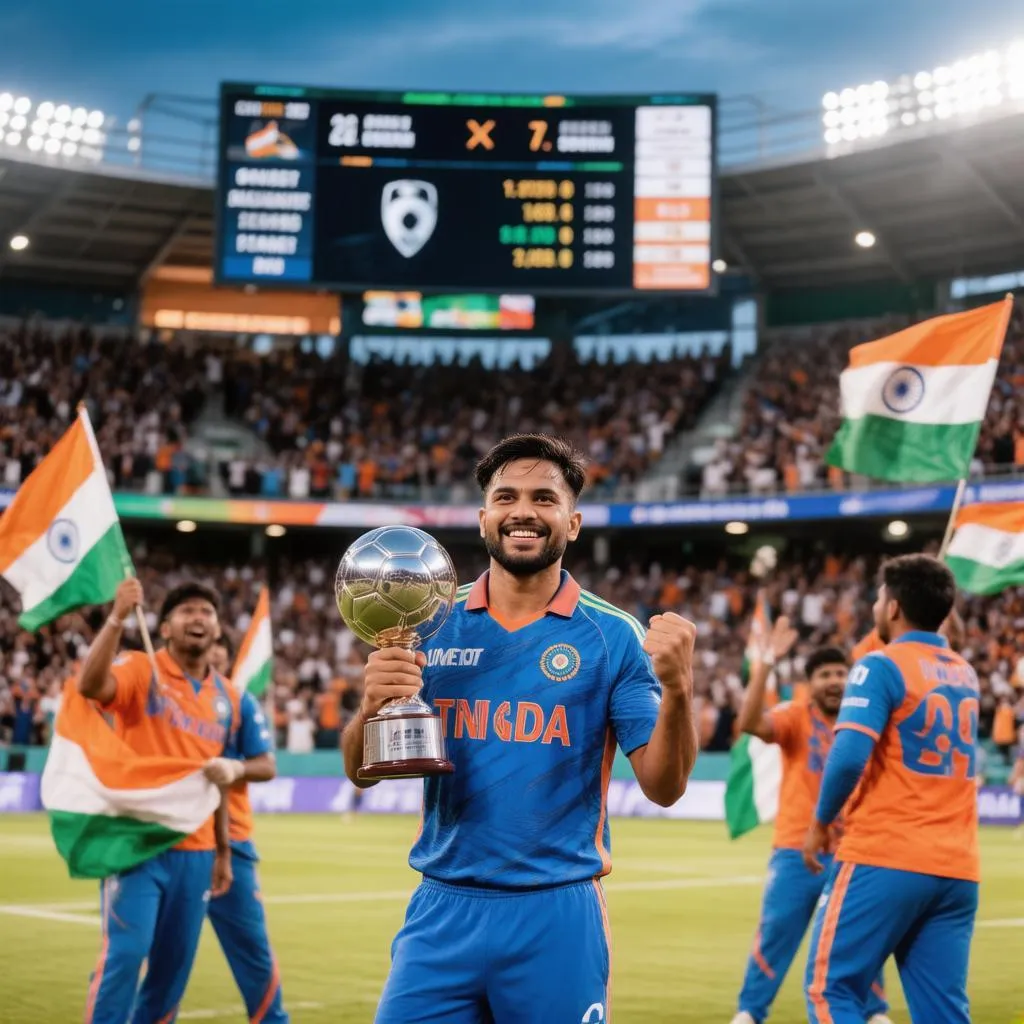
Some tournaments are campaigns; this one was a coronation. The ICC Men’s T20 World Cup 2026 ran from February 7 to March 8 across India and Sri Lanka, and it ended the only way the home crowd dreamed of: with India beating New Zealand by 96 runs in the final at the Narendra Modi Stadium in Ahmedabad, defending the title they won in 2024 and becoming the first team in history to win three Men’s T20 World Cups. Under first-time captain Suryakumar Yadav, with Rohit Sharma, Virat Kohli and Ravindra Jadeja all gone from the T20I setup, this was meant to be a rebuilding cycle. Instead, it became the most dominant white-ball run Indian cricket has ever produced — and it sets the tone for the 50-over World Cup coming in late 2027.
The campaign: one wobble, one party
India entered as defending champions and co-hosts, placed in Group A alongside Pakistan, the USA, the Netherlands and Namibia. The group stage and Super Eights followed the same 20-team, four-group format as the 2024 edition, with every match carrying net-run-rate consequences. India sailed through the group, and the one genuine stumble came in the Super Eights, where South Africa handed India their only defeat of the tournament in Ahmedabad — a loss that briefly prompted the familiar panic, before the team answered in the best possible way by sweeping the knockout rounds.
The semifinal against England in Mumbai produced the highest match aggregate in Men’s T20 World Cup knockout history — 499 runs across the two innings — with India holding firm to reach a third final in four editions. New Zealand, who demolished South Africa in the other semifinal, arrived at Ahmedabad having never beaten India in a Men’s T20 World Cup match. That streak held, emphatically.
The final, blow by blow
Ask India to post a total in a World Cup final and they wrote a new chapter. Sanju Samson, restored to the top of the order after Shubman Gill’s omission from the squad, played the innings of his life: 89 off 46 balls with eight sixes, the highest individual score ever recorded in a T20 World Cup final. Abhishek Sharma raced to 52 off 21 deliveries, Ishan Kishan blazed 54 off 25, and India crossed 200 inside 15 overs on the way to 255 for 5 — the highest total in a T20 World Cup final and the second-highest of the whole tournament.
Then came the demolition. Jasprit Bumrah, bowling off-pace on 21 of his 24 deliveries, returned 4 for 15, removing Finn Allen and Glenn Phillips early and dismantling the middle order; Axar Patel chipped in with 3 for 27. New Zealand were bowled out for 159 in 19 overs, and India had their record margin — 96 runs, their biggest in T20 World Cup history. Over 86,000 fans watched it, and it broke two hoodoos at once: the New Zealand jinx at T20 World Cups and Ahmedabad’s reputation as India’s graveyard after the 2023 ODI final heartbreak there.
The numbers behind the run
Individual scores tell only part of the story. The collective picture — numbers crunched across the tournament — is what turned this team into a statistical marvel:
| Player | Role | Tournament mark |
|---|---|---|
| Sanju Samson | Wicketkeeper-batter | Player of the Tournament: 321 runs in 5 matches at a strike rate of 199.37 |
| Jasprit Bumrah | Fast bowler | 4 for 15 in the final, Player of the Match; the tournament’s control point |
| Abhishek Sharma | Opener | 52 off 21 balls in the final, powerplay platform-setter, world No. 1 T20I batter |
| Ishan Kishan | Wicketkeeper-batter | 54 off 25 in the final after a recall earned through domestic form |
| Axar Patel | Vice-captain, spinner | 3 for 27 in the final, dual value with bat and ball |
What makes Samson’s Player of the Tournament award remarkable is the context: he began the cycle as the opener who had lost his spot, entered the World Cup as a squad player seemingly behind Gill, and finished as the best performer in the entire event. In five innings he rewrote his own career narrative — and, in the process, made India’s selection call look like genius rather than gamble.
Why this team won: the quiet design
Beneath the highlights sits a strategy that dates to the aftermath of the 2024 triumph, when the leadership deliberately rebuilt the side rather than patching it. Ricky Ponting called this group arguably the strongest T20I team ever assembled, and the basis for that claim is visible in how the pieces fit. The pillars:
- Role clarity over reputations. Every batter had a defined lane — Abhishek’s powerplay violence, Samson’s anchoring aggression, Tilak Varma and Rinku Singh as middle-overs and death specialists — with no one playing for individual averages.
- Spin supremacy. Varun Chakravarthy, the world’s No. 1 T20I bowler, and Kuldeep Yadav formed a wrist-spin pairing that strangled middle overs across conditions, a rarity in an era built for pace.
- Bumrah as the safety net. The attack’s ace ran his deception off-pace, mixing 21 of 24 final deliveries under 128 kph while New Zealand’s seamers went for 83 runs off 32 balls for a single wicket in the final.
- A captain learning publicly. Suryakumar Yadav, given the job after 2024 with no prior ICC event as leader, backed young players through lean patches and rotated fearlessly — the trust repaid in knockouts.
The results validate the design: since 2023, India have won 31 of 33 ICC white-ball matches, including 25 of 27 in multi-nation T20I tournaments, with the single T20I loss being the South Africa Super Eights defeat. Those are not runs of form; they are the signature of a system.
What the 2026 win does not solve
Honesty demands the other side of the ledger. This triumph belongs entirely to the T20 format, and several questions follow the team home:
- The 50-over test comes next. The ODI World Cup in South Africa, Zimbabwe and Namibia in late 2027 is a different exam: longer innings, different roles, and a squad that must decide how the T20 core maps onto 50 overs.
- Transition at the top remains unfinished. Gill was dropped for fitness and form; Rohit and Kohli are retired from T20Is but their ODI futures were separate stories even before this tournament. The 2027 ODI campaign will need its own batting spine.
- Workload management gets harder. Back-to-back titles create expectations of back-to-back dominance, but the players who carried this tournament — Bumrah especially — have long injury histories that demand careful scheduling between now and 2027.
- The New Zealand shadow lingers. Mitchell Santner’s side reached their fourth ICC final without winning one; they will return hungrier, and so will a South African team that beat India once already in this event.
None of these caveats dims the achievement. They simply mean the 2026 trophy is a milestone, not a destination.
The road to 2027
The calendar now bends toward the ODI World Cup, and the lessons of 2026 travel with it. Selection meetings will weigh a core that has just proven itself in the pressure-cooker of home conditions: Samson’s redemption, Kishan’s recall vindicated, Abhishek’s fearless batting, Bumrah’s control. Some of that translates directly to 50-over cricket; the ultra-aggressive powerplay model, for instance, needs recalibration in a format where early wickets matter differently. What does not change is the psychological dividend — this squad has now won a World Cup on home soil, defended a title, and closed out a final with authority, and those experiences are the hardest currency in sport.
For Indian cricket, 2026 answered the question the sport kept asking since 2024: could this new-look team win without its old guard, and could it do it at home after the ghosts of Ahmedabad? The answer came in 96 runs of confirmation. The next question — whether this machine, now the team to beat in every format conversation, can carry its dominance into the 2027 World Cup — is already the one dominating every planning meeting at the BCCI. If 2026 taught anything, it is that this team does not fear the question; it has spent two years building the answer.