
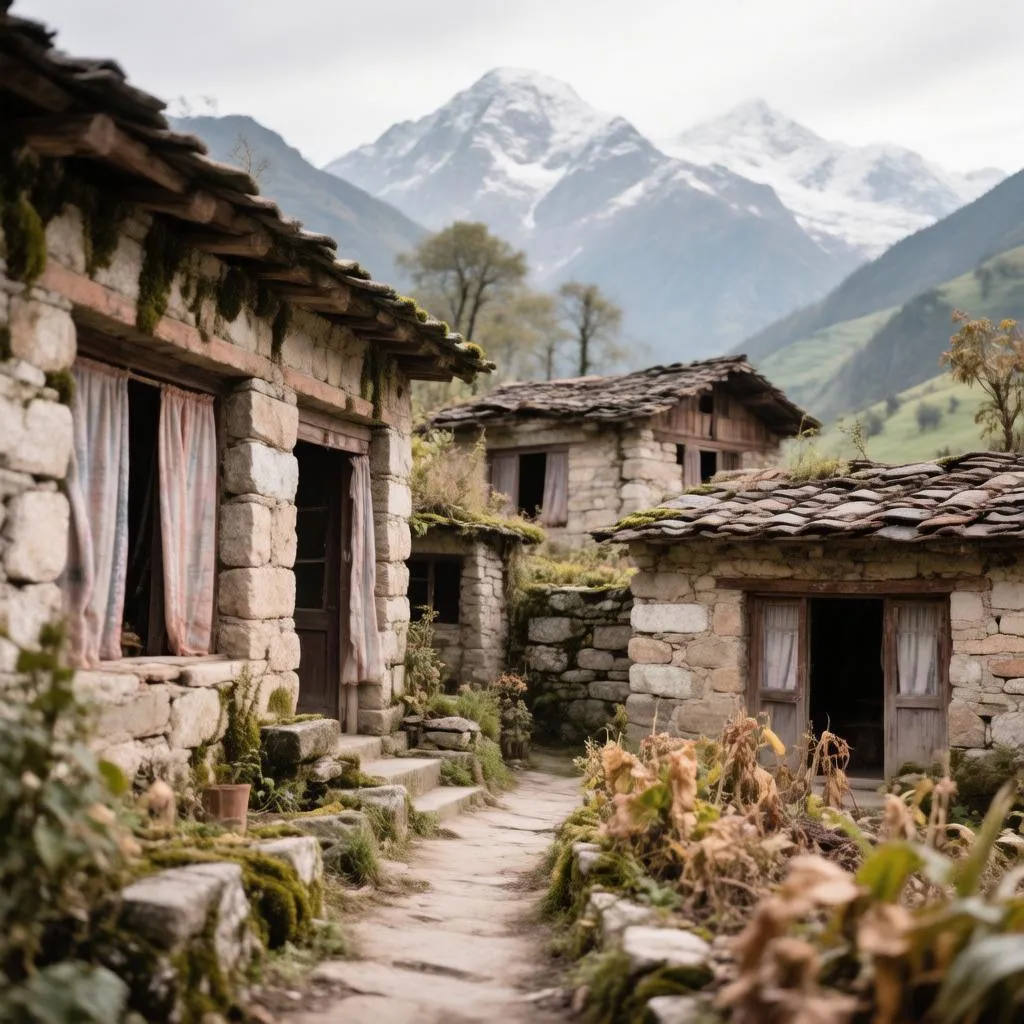
Drive the mountain roads above Almora or Pauri Garhwal and the landscape performs a quiet trick: terraced fields still climb the slopes in perfect steps, stone houses still stand with slate roofs intact, and yet no smoke rises from the chimneys and no voice carries across the valley. Uttarakhand’s “ghost villages” — the abandoned settlements scattered across its hill districts — are not ruins of some ancient catastrophe. They are recent, ordinary houses left by families who moved out within living memory, some within the last decade, and they represent one of the most significant internal migrations in modern India. Official surveys have recorded thousands of villages across the state as functionally empty or reduced to a handful of elderly residents, and the numbers keep a stubborn rhythm: roughly one in every five to six villages in some districts has lost its population almost entirely. The phenomenon has a name in the local press, a growing literature in the state’s own debates, and causes that are neither mysterious nor singular. Understanding why thousands left — and what remains behind, from standing houses to contested land records to quiet revivals — means understanding the Himalaya’s demographic fault line, which this guide traces from data to causes to consequences to the counter-movement now trying to reverse them.
The scale: what the numbers say
The most cited figure in Uttarakhand’s migration debate comes from a 2018 state survey that found around 700 villages across the hill districts effectively depopulated, with several thousand more half-emptied. Subsequent studies and local reporting have kept the conversation alive with similar patterns: the hill districts of Almora, Pauri Garhwal, Tehri and Pithoragarh have recorded the sharpest losses, while the plains districts of Dehradun, Haridwar and Udham Singh Nagar have absorbed the inflow. The state’s own planners use the phrase “zero-population villages” for settlements where the last resident has left, and the count of such villages has varied between studies — but the direction of every dataset is the same.
| District group | Migration pattern | Typical village profile |
|---|---|---|
| Pauri Garhwal, Almora | Among the highest out-migration rates | Old settlements with a majority of residents over 60; schools closed |
| Pithoragarh, Champawat | High out-migration, border-area depopulation | Scattered hamlets; farmland reverting to forest |
| Tehri Garhwal | High losses, displacement layered over migration | Villages around the reservoir with their own displacement history |
| Dehradun, Haridwar | Net inflow | Migrant destinations; urban slums and peri-urban growth |
| Udham Singh Nagar | Net inflow | Agricultural plains absorbing hill migrants |
The table’s sharpest detail is the last row’s relationship to the first three: the hill districts empty and the plains fill, and the two patterns are one migration, not two phenomena. A Pauri family that abandons its stone house typically relocates to Haridwar or Dehradun, where the children can attend a functioning school, the parents can find wage work and the elderly can reach a hospital without a day’s walk. What looks like a rural crisis is, from the migrant’s side, an urban access story — and that framing matters, because the policy responses that fail are the ones that treat abandonment as a mystery rather than a rational choice.
Why they left: the compound causes
No single cause emptied the hill villages; a stack of them did, each one plausible on its own and compounding in combination. The reasons families cite when researchers ask fall into a recognizable hierarchy, and understanding the hierarchy matters because it shows where intervention can work and where it cannot.
The principal drivers, in the order villagers themselves rank them:
- Jobs, or the absence of them. Hill agriculture in Uttarakhand operates on small terraced plots that cannot generate cash income at modern scale, and the non-farm economy of the hills — tourism, small trade, services — is too thin to absorb a young workforce. Employment, not education, is the first reason in nearly every survey.
- Education. Higher secondary schools and colleges concentrate in towns; a family with a child in Class 10 or above faces a daily commute of hours or a boarding arrangement that quietly becomes permanent relocation. The school-closure cascade — a village school shuts because enrollment falls, so families leave, so enrollment falls further — is the most self-reinforcing loop in the entire phenomenon.
- Healthcare distance. For elderly parents living alone, the calculus reverses: a hospital three hours away on foot and road turns old age into a dependability crisis, and adult children relocate to be near care rather than leave parents behind. The aging population that remains in ghost villages is simultaneously a consequence of migration and its cause.
- Wildlife conflict. Leopards, monkeys, wild boar and, in higher belts, bears have escalated their pressure on hill farms as human presence thinned, and crop losses from animals now push marginal farmers over the line from difficult to pointless. The state’s compensation schemes exist but move slowly, and the fields closest to forest are the first to be abandoned.
- Fragmented land and inheritance. Division across generations has split terraces into parcels too small to farm efficiently, and the children of a family that owns three scattered half-acre plots have no economic future holding them.
- Water and climate stress. Springs — the hill’s traditional water source — have become less reliable across decades, and changing rainfall patterns have shifted cultivation seasons. Where the water source failed, the village emptied fastest.
- The aspiration gap. Younger generations have watched television, phone networks and migrant relatives from the plains, and the life they aspire to — salaried, connected, mobile — does not exist in the village they were born into. This is not a failure of the hills; it is the gravity of the modern economy, and it pulls from every small settlement in every developing country.
The honest reading of this list is uncomfortable for both sides of the migration debate. For those who romanticize the hills, the list shows that nostalgia is not a policy: no subsidy for staying can outweigh the pull of schools and hospitals for a family with children. For those who see abandonment as inevitable, the list shows that the push factors — wildlife conflict, water, land fragmentation — are tractable where the pull factors are not, and the villages that survive are precisely the ones where the tractable problems were solved.
What remains: the abandoned landscape
The ghost villages are not picturesque ruins. They are functioning houses — stone walls, slate roofs, carved wooden doorframes — standing weather-tight in a landscape where nature reclaims everything except the buildings themselves. The terraces remain cut; the irrigation channels remain dug; the temples remain maintained by whoever visits last. What disappears first is the living infrastructure: the school closes, the fair-weather road goes unmaintained, the water source silts up, the electricity connection lapses. What remains last is the cemetery, and the families who return twice a year for the ancestral shrines keep a thread of connection that urban planners consistently underestimate.
Three categories of what remains tell the story:
- Standing houses held by absent families. Most emigrants did not sell; they locked up. Property records, succession disputes and the psychological weight of ancestral land keep ownership intact while use collapses, and this frozen ownership is now the central obstacle to every revival scheme — an organization cannot lease or rebuild what it cannot legally acquire.
- Land reverting to forest. Uncultivated terraces in Uttarakhand revert to pine and oak within a decade, and the regrowth changes the ecology: pine forests raise fire risk and lower water retention, a consequence that feeds back into the water stress that helped drive the migration out.
- The skeleton economy. A handful of elderly residents, a shopkeeper who serves three villages, a bus route that runs “when needed” — the thin remaining infrastructure is what makes partial revival possible, because the seed of a functioning settlement still exists where a few families chose to stay.
The stayers are the quiet heroes of the entire story. In every emptied village, a household or two remains — usually elderly, usually farming at subsistence scale, usually refusing relocation on cultural grounds. Their presence keeps the roads open, the temples alive and the village on official maps; their absence would convert the settlement from “depopulated” to “extinct” in a single administrative revision.
The policy response: schemes and their limits
Uttarakhand’s government has responded to the phenomenon with a sequence of initiatives, and the pattern of their success and failure is itself instructive. The flagship programs — home-stay tourism subsidies, rural employment schemes, spring-revival projects, horticulture promotion and the “return to villages” incentives for migrated families — have each recorded genuine successes and documented shortfalls, and the difference between the two follows a rule that the hill administration has learned slowly.
What has worked, and what has not:
- Home-stays and tourism have revived specific villages, not the general problem. Settlements with a distinctive feature — a temple, a trekking trail, a view — converted abandonment into opportunity with state support, but the scheme’s arithmetic only works where visitors exist, and most ghost villages have no visitor economy to build on.
- Spring revival and water conservation have shown the clearest structural returns: villages where water sources were restored through community-led recharge work recorded slowed or reversed out-migration in follow-up studies. Water is the one intervention where the causal chain from investment to retention is short and demonstrable.
- Horticulture and high-value agriculture have created income where they were paired with market access — apple belts, herb cultivation, off-season vegetables — and failed where produce had no road or buyer. The lesson is that agriculture revival is a logistics problem before it is an agronomy problem.
- Cash incentives for return have consistently underperformed. Families that left for schools and hospitals do not return for a subsidy; the pull factors must be neutralized by services before any incentive matters.
The pattern across all four points is the same: infrastructure and market access produce retention; announcements and subsidies do not. The villages that reversed their decline did so through water, roads, schools and buyers — not through campaigns.
The counter-movement: who is coming back
Not every story is departure. A quiet reverse migration has gathered pace in the last several years, driven by three overlapping groups, and it represents the most realistic path to partial revival. Remote workers — freelancers and employees whose jobs survived the digitization of the early 2020s — have discovered that a hill village with broadband costs a fraction of a city and offers a quality of life the plains cannot match. Retired returnees, the first generation of migrants now reaching their sixties, are coming home to the villages they left at twenty, restoring houses and spending pensions locally. And young entrepreneurs — often the children of migrants — are opening cafés, guesthouses, adventure-tour operations and craft businesses in villages their parents abandoned, betting on the tourism economy the state has been subsidizing.
This counter-movement has its own structural needs, and the state’s response to them is the current frontier of the debate. Broadband reaches most village panchayats but not always reliably; road maintenance in the abandoned belts is sporadic; land-transfer rules complicate every business that needs premises; and the school-and-hospital problem that drove the exodus remains unsolved for returnees with children. The villages that have absorbed returnees successfully — the ones with working internet, a road that stays maintained and a government school within reach — offer a template the administration is now studying: revival is possible, but only where the exodus’s causes were addressed rather than merely lamented.
Conclusion
The ghost villages of Uttarakhand are not a mystery and not a tragedy in the simple sense. They are the visible record of thousands of rational decisions made by families weighing jobs, schools, hospitals and aspiration against terraced fields that could feed but not fund them. The empty stone houses are the residue of that arithmetic — and the arithmetic is the thing that has to change if the villages are to fill again.
What remains behind is more than ruins: owned houses with intact titles, terraced land reverting to forest, a skeleton economy of stayers and shrines, and in a growing number of settlements, the first signs of return. Where water was restored, roads maintained and markets connected, some villages have bent their curves back; where subsidies replaced infrastructure, the houses stand emptier than ever. The future of the ghost villages will not be decided in the villages themselves but in the three decisions that hollowed them out — whether a family can earn, educate and heal within reach of the ancestral home. Until those three answers change, the terraces will keep quieting. And when they do change, the Himalaya has shown it is patient: the houses are still standing, the stones remember the families, and the return, wherever it has begun, has never needed to be persuaded — only made possible.