
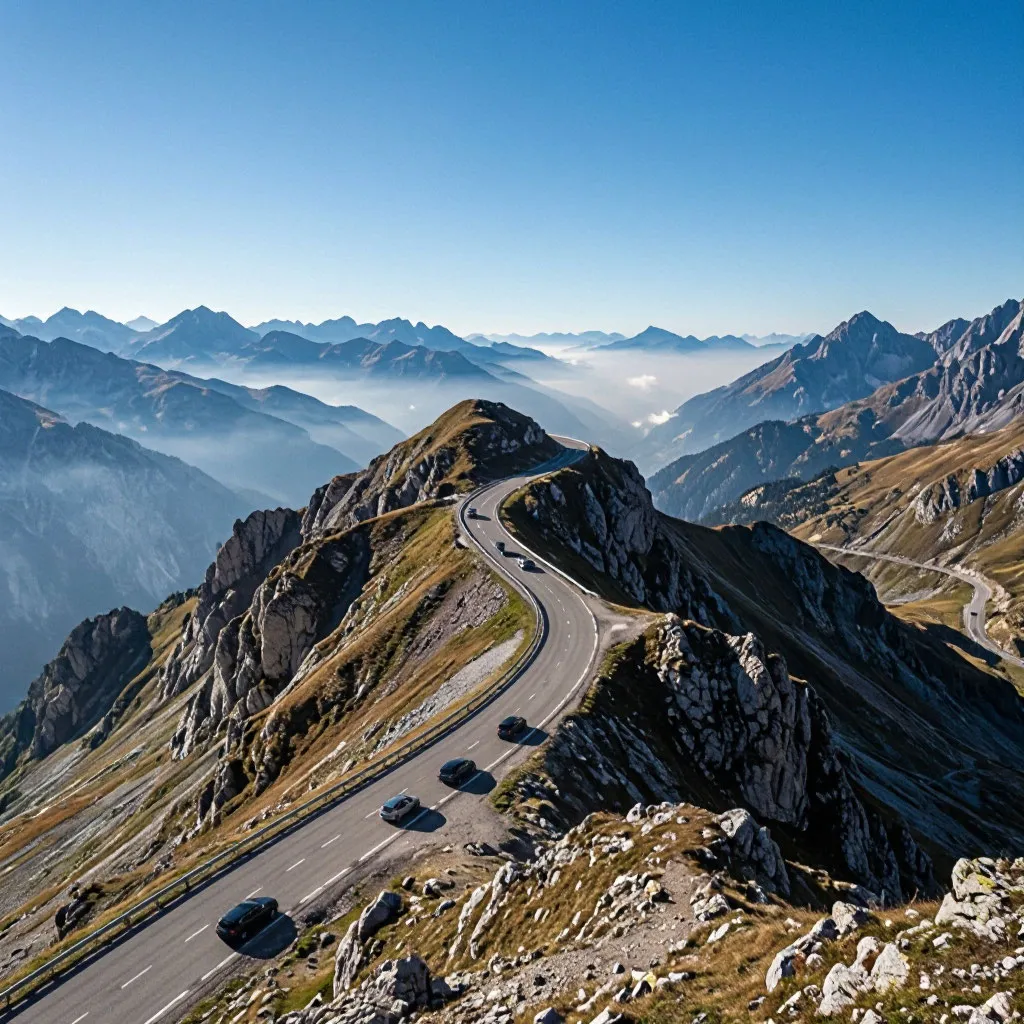
Picture a desolate stretch of asphalt on the Leh-Kargil National Highway, surrounded by barren brown mountains under a sky so wide it feels like the edge of the world. A yellow signboard by the roadside reads “The Phenomenon That Defies Gravity.” You stop your car at a white-painted box on the road, shift into neutral, switch off the engine — and your vehicle begins to move. Not backwards, not downhill as you’d expect, but apparently uphill, gaining speed until it reaches around 20 km/h with no visible force pushing it. Anyone who has experienced this at Magnetic Hill, roughly 30 kilometres west of Leh at an altitude of 14,000 feet, will understand why it has become one of India’s most talked-about natural curiosities. The question that has echoed through travel blogs, scientific papers, and dinner-table debates is the same: is something genuinely pulling these vehicles against gravity, or are thousands of visitors each year being fooled by one of nature’s most elegant tricks?
Where exactly is magnetic hill and what do visitors experience
Magnetic Hill sits on the Leh-Kargil-Baltik National Highway (NH-1), approximately 30 kilometres from Leh town and about 7.5 kilometres southeast of the village of Nimmoo. The Indus River flows to the east, adding to the dramatic setting. GPS coordinates place the marked observation zone at roughly 34.17°N, 77.35°E. A painted box on the road surface indicates the exact spot where drivers are told to park, and the surrounding slopes of the valley create a backdrop that makes it nearly impossible to judge the true gradient of the road by eye.
The experience itself is striking. Vehicles placed in neutral at the marked box appear to creep forward and uphill, picking up speed as they go. Some travellers report speeds of up to 20 km/h. The sensation is powerful enough that even people who know the scientific explanation report a visceral feeling that something is wrong with gravity. Bikes, cars and even buses seem to defy the laws of physics. Local shopkeepers near the site have turned the phenomenon into a small economy, selling tea and snacks to tourists who stop to test the effect.
The three theories that attempt to explain the phenomenon
Over the years, three main explanations have circulated among locals, travellers, and researchers. Each carries a different weight of evidence, and understanding all three is necessary before drawing any conclusion about what is really happening on that stretch of highway.
- The magnetic force theory: The most popular layperson explanation claims that the hill emits a powerful magnetic field strong enough to pull metallic vehicles uphill. This theory is bolstered by an oft-repeated claim that Indian Air Force pilots avoid flying over the area to prevent magnetic interference with their instruments. No official documentation from the Indian Air Force has ever confirmed this claim, and the scientific study that directly measured magnetic intensity at the site found readings entirely within normal Earth surface parameters.
- The optical illusion theory: The explanation endorsed by virtually every scientist who has studied the site. The surrounding landscape — barren mountains, a distorted horizon, and the absence of familiar reference points like trees or buildings — creates a visual environment where the human brain misinterprets a downhill slope as an uphill one. The vehicle is simply rolling downhill, exactly as gravity demands.
- The spiritual pathway theory: Rooted in local Buddhist and folklore traditions, this belief holds that the hill was once a road to heaven. Those with good karma were pulled upward; those without could never make the ascent. While charming and culturally significant, this explanation has no bearing on the physical mechanism at work.
Among these three, only the optical illusion theory has survived scientific scrutiny. The magnetic force theory collapses under direct measurement, and the spiritual tradition, while culturally valuable, belongs to the realm of belief rather than physics.
What scientists found when they actually measured the magnetic field
In 2018, a team of researchers from the Rajasthan Institute of Engineering and Technology in Jaipur conducted the most thorough magnetic survey of Magnetic Hill published to date. Led by Sanjay Lakshminarayana, the team used a magnetometer to measure magnetic intensity at multiple points: on the road itself, circling the hill, and at the hilltop. Their findings were unambiguous.
The average magnetic intensity at the road was approximately 51 microteslas (μT). Circling the hill produced readings of about 51.7 μT. At the hilltop, the highest readings were recorded at roughly 55 μT with occasional peaks of 58 μT. All of these values fall comfortably within the normal range of Earth’s surface magnetic field, which typically varies between 25 and 65 μT depending on location and geology. The team also tested a magnetic compass, which showed no abnormal fluctuation, and experimented with iron filings and a strong natural magnet — none of which produced any observable attraction effect.
The study concluded with a statement that leaves little room for ambiguity: the magnetic field at Magnetic Hill is nowhere near strong enough to cause any push or pull on objects of any size. The researchers attributed the perceived “magnetic effect” reported by some visitors to a combination of psychological suggestion and the high-altitude environment. They also noted that the rolling motion of a test bike — reaching about 22 km/h in one direction and 17 km/h in the reverse — was consistent with the negative gradient of the tarmac, not with any magnetic interference.
How the landscape tricks the brain: the science of gravity hills
Magnetic Hill in Leh belongs to a well-documented category of geographical features known as gravity hills. These are locations worldwide where the layout of the surrounding terrain creates an optical illusion so convincing that a downhill slope appears to go uphill. The effect is not unique to Ladakh — it has been studied extensively by psychologists and physicists, and the mechanism is now well understood.
The key factor is the horizon. Human perception of slope depends heavily on visual reference points. When the horizon is clearly visible, the brain can accurately judge whether a surface tilts up or down. But when the horizon is obscured, tilted, or distorted by surrounding terrain — as it is at Magnetic Hill, where barren mountains block the true horizon line — the brain loses its most reliable reference and begins to rely on contextual cues from the landscape. These cues, formed by the angle of the mountains and the valley walls, can create a false impression that the road slopes upward when it actually slopes downward.
A landmark 2003 study by researchers at the Universities of Padua and Pavia in Italy tested this mechanism under controlled laboratory conditions. The team built tabletop models of several real gravity hills from around the world and invited volunteers to observe them through a viewing hole that simulated the perspective of standing on the road. The researchers systematically varied the height of the visible horizon, the slant of visible road stretches, and the angle of contextual inclines. Their results, published in Psychological Science, were definitive: without a true horizon in sight, the human brain misjudged slopes based on surrounding visual cues. When a small roll of tape was placed on the misperceived slope, it appeared to roll against gravity — producing, as the researchers noted, “surprise and, on occasion, reverential fear” among observers.
The study identified three specific perceptual mechanisms that combine to create the illusion:
- Perceived slope depends on the height of the visible horizon. When the horizon is lower than expected or obscured by terrain, the brain misjudges the angle of the road relative to level ground.
- Surface slant tends to be underestimated relative to the horizontal plane. The brain consistently flattens perceived gradients when visual references are poor, making a downhill slope feel closer to flat or even reversed.
- A slightly downhill stretch preceded, followed, or flanked by a steep downhill slope is perceived as uphill. The contrast between the steeper surrounding slopes and the gentler road gradient creates a relative perception that flips the direction of the road in the observer’s mind.
These three mechanisms work together at Magnetic Hill. The valley walls and mountain slopes surrounding the road create a false horizon that is higher than the true one. The road itself has a gentle downhill gradient — estimated at around 2-3% based on comparative studies of similar gravity hills — but because the surrounding terrain slopes downward at a steeper angle, the road appears to rise relative to its backdrop. Without trees, buildings, or any other familiar vertical references to correct the misperception, the brain accepts the illusion as reality.
How Leh’s magnetic hill compares to other gravity hills worldwide
Gravity hills are not rare geological anomalies — they exist on every inhabited continent. What makes each one unique is the specific landscape configuration that creates the illusion, but the underlying mechanism is identical everywhere. Examining a few of the most famous examples helps put the Leh site in global context and reinforces that this is a universal perceptual phenomenon rather than a local magnetic oddity.
| Location | Country | Key feature | Magnetic claim |
|---|---|---|---|
| Magnetic Hill, Moncton | Canada (New Brunswick) | Tourist attraction since the 1930s with a dedicated park and visitor centre | Named after the magnetic force theory, debunked by GPS surveys |
| Electric Brae, Ayrshire | Scotland (UK) | Famous since the 19th century; named after the then-new technology of electricity | No magnetic anomaly; classic obscured-horizon illusion |
| Spook Hill, Lake Wales | USA (Florida) | Local legend attributes the effect to a battle between an alligator and a Native American chief | No magnetic anomaly; landscape creates the visual effect |
| Mount Aragats | Armenia | Located on the road to Lake Kari; cars appear to roll uphill on the slopes of a 4,090m peak | Often called a “sibling” of Leh’s Magnetic Hill; same optical illusion mechanism |
| Wadi Al Baida | Saudi Arabia | Known locally as the “Valley of Jinn”; vehicles appear to move on their own | DEM analysis confirmed an average downhill slope of 2.6% |
| Jeju Mysterious Road | South Korea | Located on Jeju Island; surrounded by volcanic formations | No magnetic anomaly; volcanic landscape distorts the horizon |
Each of these sites shares the same fundamental characteristics: a gentle downhill road gradient, surrounding terrain that obscures or distorts the true horizon, and a lack of reliable vertical reference points. The Wadi Al Baida case in Saudi Arabia is particularly well-documented, as researchers created a full Digital Elevation Model of the valley and confirmed that the endpoint of the road sits significantly lower in elevation than the starting point — the road slopes downhill at an average of 2.6%, and vehicles move along it due to nothing more exotic than gravity. The Canadian Magnetic Hill in Moncton has been a commercial tourist attraction since the 1930s, complete with a visitor centre and entrance fee, despite physicists from Pennsylvania State University confirming through GPS measurements that the road runs downhill. The fact that gravity hills on four different continents, in wildly different geological settings — volcanic islands, Himalayan valleys, Arabian deserts, and Scottish coastlines — all produce identical illusions through the same perceptual mechanism is perhaps the strongest evidence that the explanation is universal.
The Indian Air Force claim: fact or fiction?
One of the most persistent stories associated with Magnetic Hill is that Indian Air Force pilots deliberately avoid flying over the area to prevent magnetic interference with their navigational instruments. This claim appears in numerous travel articles and blog posts, usually presented as evidence that the hill’s magnetic field is strong enough to affect aircraft equipment. The logic seems appealing: if military pilots take the phenomenon seriously enough to reroute, surely there must be something to it.
The problem is that no official Indian Air Force document, statement, or flight advisory has ever been produced to substantiate this claim. The 2018 magnetic survey by Lakshminarayana and his team found magnetic intensity readings of 51-55 μT — values so normal that a compass needle showed no irregular behaviour. For context, a typical refrigerator magnet produces a field of about 5,000 μT at its surface, roughly a hundred times stronger than anything measured at Magnetic Hill. If the hill’s magnetic field cannot deflect a compass needle, it certainly cannot interfere with the shielded avionics of a military aircraft flying hundreds or thousands of feet above.
The claim likely originated as a traveller’s anecdote that was repeated enough times to acquire the veneer of fact. In the high-altitude environment of Ladakh, where the air is thin and the landscape is disorienting, stories of magnetic interference feel plausible. But plausibility is not evidence, and in this case the evidence directly contradicts the story.
What GPS measurements reveal about the actual slope
If the magnetic theory fails and the optical illusion theory holds, there should be physical proof that the road slopes downhill. That proof exists, and it comes from the same technology that powers navigation apps on every smartphone: GPS-based elevation measurement.
Physicists at Pennsylvania State University, led by materials physicist Brock Weiss, conducted GPS measurements at a gravity hill in Bucks County, Pennsylvania, and confirmed that the elevation at the start of the apparent “uphill” section was higher than at the end. The road that looked uphill was, in reality, sloping downhill. Weiss stated plainly: “You are, indeed, going downhill, even though your brain gives you the impression that you’re going uphill.”
While no comparable GPS survey has been published specifically for the Leh Magnetic Hill, the 2018 Indian study confirmed that a test bike rolled at 22 km/h in one direction and 17 km/h in the other — a difference consistent with a negative road gradient, not with a magnetic field. The Saudi Arabian DEM study of Wadi Al Baida, a structurally analogous gravity hill, demonstrated a 2.6% downhill slope through rigorous geospatial modelling. The geological context of the Leh site — a valley basin in the Indus Suture Zone, surrounded by mountains that descend on both sides — is textbook terrain for producing the visual conditions required for a gravity hill illusion.
The barren landscape of Ladakh is particularly effective at creating this illusion precisely because it lacks the visual references that would normally allow the brain to correct itself. In a forested area, trees grow vertically and provide an immediate sense of what is level. In a city, buildings and streetlights serve the same function. On the high-altitude desert of the Leh-Kargil highway, there are no trees, no buildings, no poles — nothing except the road itself and the surrounding mountains, which are tilted in exactly the way needed to make a downhill road appear to climb.
The geological context: why this spot and not every road in Ladakh
Not every stretch of road in Ladakh produces the gravity hill effect, which raises a reasonable question: what makes this particular location special? The answer lies in the specific combination of road gradient, surrounding topography, and horizon obstruction that converges at this single point along the highway.
The Leh-Kargil highway runs through the Indus Suture Zone, the geological boundary where the Indian and Eurasian tectonic plates collided millions of years ago to form the Himalayas. The valley basin surrounding Magnetic Hill is flanked by mountains on both sides, with the road running roughly parallel to the Indus River. At the specific point marked by the painted box, the road has a gentle downhill gradient of approximately 2-3%, but the mountains on either side slope downward at a steeper angle. This creates a situation where the road, relative to its immediate visual backdrop, appears to rise — even though it is physically descending.
A few hundred metres in either direction, the effect disappears because the alignment of the road and the surrounding terrain shifts. The illusion requires a very specific geometric relationship between the road gradient, the surrounding slopes, and the observer’s position. Move the observation point even a short distance and the visual cues change enough to break the effect. This precision is what separates a gravity hill from an ordinary downhill road — and it is entirely a product of geology and topography, not of magnetism or supernatural forces.
Visiting magnetic hill: practical information for travellers
For those planning to visit Magnetic Hill, the experience remains worth the stop even knowing the scientific explanation. The site is easily accessible from Leh, the road is well-paved, and the illusion is genuinely powerful even for informed visitors.
The best time to visit is between July and September, when the highway is clear of snow and weather conditions are stable. The drive from Leh takes about 45 minutes. There is no entrance fee, and the marked box on the road indicates where to position your vehicle. Putting the car in neutral and watching it appear to roll uphill is a sensory experience that no amount of scientific knowledge can fully override — the brain simply refuses to accept that what it sees is wrong. The nearby confluence of the Indus and Zanskar rivers, about 6 kilometres further west, is one of the most spectacular natural sights in Ladakh and makes the trip doubly worthwhile.
For travellers who want to test the illusion more rigorously, a simple GPS-based elevation app on a smartphone can provide a rough confirmation. Recording the elevation at the painted box and then at a point 50-100 metres further along the apparent “uphill” direction will typically show a lower elevation at the second point — physical proof that the road descends. Alternatively, pouring water on the road surface will show it flowing in the apparent “uphill” direction, because water, unaffected by optical illusions, always follows gravity downhill.
Why the illusion persists even when you know the truth
One of the most fascinating aspects of gravity hills is that knowledge of the illusion does not eliminate it. You can read every scientific study, understand every perceptual mechanism, and still watch your car appear to roll uphill with a sense of wonder. This persistence is not a failure of intellect — it is a feature of how human visual perception works.
The visual system processes slope information largely through automatic, pre-conscious pathways that operate faster than deliberate reasoning. When the horizon is distorted and familiar reference points are absent, these automatic pathways generate a perception of uphill movement that is so vivid it overrides what the rational mind knows to be true. This is the same class of illusion as the Ames room, where a distorted room makes people appear to grow and shrink as they walk across it — even when you know the room is distorted, the illusion persists because your visual system cannot help but interpret the scene according to its built-in assumptions.
At Magnetic Hill, the combination of high altitude, barren landscape, and precise topographic alignment creates one of the most convincing natural illusions on Earth. Science has explained it thoroughly: the road goes downhill, the landscape tricks the eye, and gravity works exactly as it should. But standing on that road at 14,000 feet, watching your car drift forward with the engine off, it is easy to understand why generations of travellers have felt that something extraordinary is at work. The extraordinary thing, it turns out, is not that gravity has been violated — it is that a pile of rock and a stretch of asphalt can so completely and convincingly deceive one of the most sophisticated perceptual systems ever evolved.