
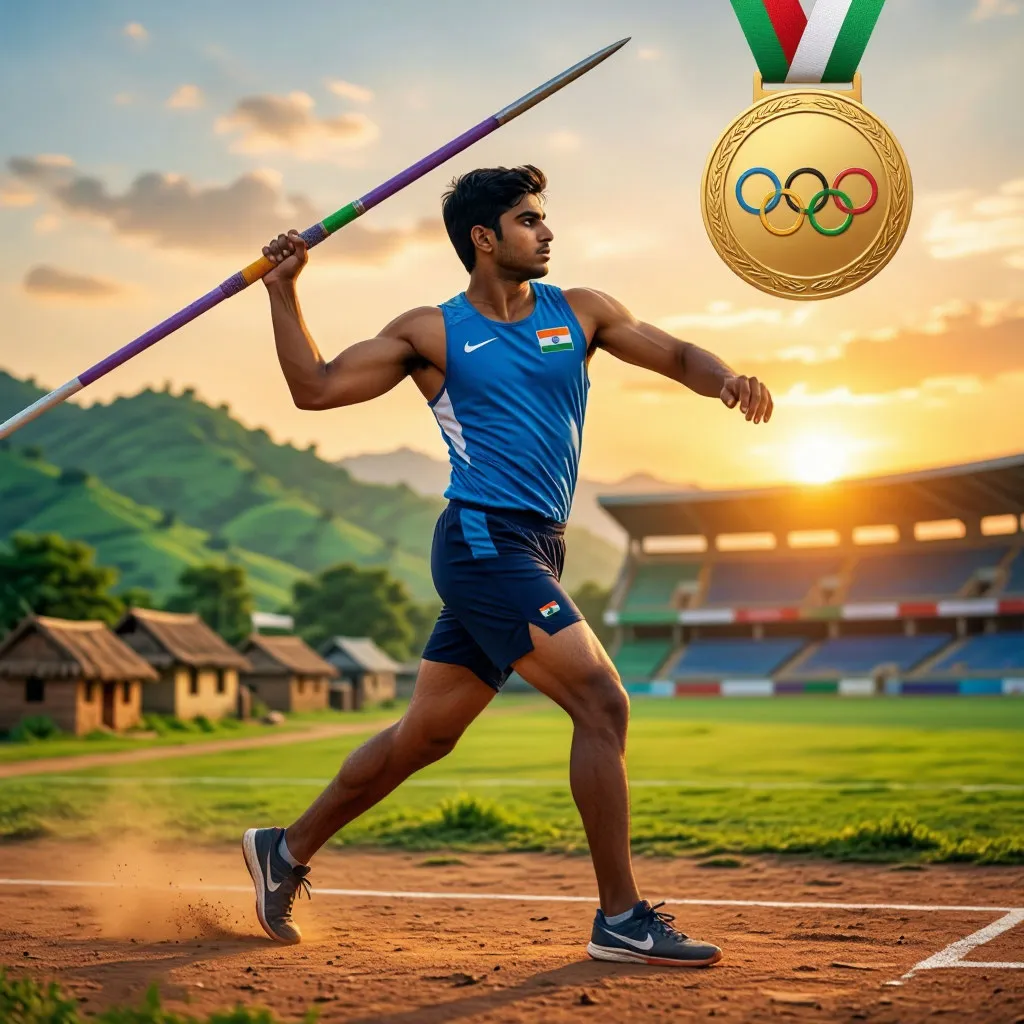
August 7, 2021, will forever remain etched in the collective memory of over a billion people. Under the bright lights of the Tokyo Olympic Stadium, a young man from Haryana stood at the start of the runway, a sleek javelin balanced in his hand. He took a deep breath, accelerated with explosive power, and let the spear fly. Before the metal tip even touched the grass, he turned around, arms raised in triumphant certainty. The javelin pierced the humid night sky, landing at eighty-seven point fifty-eight meters. With that single, majestic throw, Neeraj Chopra became a legend, ending India’s century-long wait for an individual track and field Olympic gold.
This historic moment was not a product of sudden luck. The true depth of this achievement can only be appreciated by exploring the complete Neeraj Chopra biography. His journey is an incredible testament to how grit, accidental discoveries, and unwavering focus can transform a village boy into a global icon of athletics, reshaping the destiny of sports in his country.
The rise of a champion from the fields of Khandra
To understand the roots of this athletic masterpiece, one must travel to Khandra, a quiet village in the Panipat district of Haryana. Born on December 24, 1997, into a joint family of farmers, young Neeraj was far from the picture-perfect athlete. In fact, as a child, he struggled with severe childhood obesity, weighing over eighty kilograms at just twelve years old. Teased by his peers and wearing traditional kurtas to hide his frame, his family decided he needed to engage in physical activity to build discipline and lose weight.
His uncle took him to the Shivaji Stadium in Panipat to run. There, while jogging on the track, Neeraj saw other athletes throwing the javelin. He was instantly mesmerized by the elegant, bird-like flight of the spear through the air. On a whim, he tried throwing it himself. To the astonishment of the local coaches, the untrained boy threw the javelin remarkably far. This accidental encounter marked the beginning of a legendary javelin throw champion story that would eventually rewrite the sporting history of an entire nation.
Forging the ultimate athlete: training, science, and resilience
As his natural talent became obvious, the rustic playgrounds of Haryana were replaced by professional training facilities. Neeraj moved to the Netaji Subhas National Institute of Sports in Patiala, where his raw power was refined with professional coaching. His unique throwing style combined immense natural flexibility with explosive runway speed, a rare combination in a sport often dominated by sheer muscular bulk.
To transition from a promising junior to a world-class competitor, he needed international expertise. The Athletics Federation of India brought in legendary German coach Uwe Hohn, followed by biomechanics expert Dr. Klaus Bartonietz. Under their guidance, Neeraj’s training evolved into a highly scientific routine. He focused heavily on core strength, thoracic mobility, and perfecting the block, the critical moment when a thrower stops their forward momentum to transfer all energy into the javelin.
Chronology of key achievements on the global stage
The journey to the top of the podium was built on a foundation of consistent improvements at various levels of competition. Every tournament served as a stepping stone, helping him perfect his technique and build the mental resilience required to compete against the absolute best in the world.
Looking at his competitive history reveals how steadily he climbed the ranks, setting national and international records long before his historic night in Tokyo. The progression of his throwing distances illustrates a steady climb toward athletic perfection.
| Year | Tournament | Venue | Winning throw (meters) | Major milestone achieved |
|---|---|---|---|---|
| 2016 | IAAF World U20 Championships | Bydgoszcz, Poland | 86.48 m | Set a junior world record and gained global recognition |
| 2018 | Commonwealth Games | Gold Coast, Australia | 86.47 m | Won gold on debut, proving his consistency on the big stage |
| 2018 | Asian Games | Jakarta, Indonesia | 88.06 m | Broke the national record and secured continental dominance |
| 2021 | Tokyo Olympic Games | Tokyo, Japan | 87.58 m | Secured the historic gold medal, making him a national hero |
| 2023 | World Athletics Championships | Budapest, Hungary | 88.17 m | Became the first Indian to win a World Championship gold |
| 2024 | Paris Olympic Games | Paris, France | 89.45 m | Won the silver medal, cementing his status as a legendary thrower |
This impressive record shows that his success was the result of a carefully planned progression. By consistently delivering world-class performances across different continents and under extreme pressure, he proved that his Olympic gold was not an isolated event but the logical result of years of scientific training and unmatched dedication.
Biomechanical breakdown of a perfect javelin throw
A javelin throw looks incredibly smooth, but it is actually one of the most violent and complex movements in all of sports. The athlete must run at full speed and then come to a sudden halt, channeling all that kinetic energy up through their leg, hip, torso, shoulder, and finally out through the fingertips into the spear.
To achieve this level of efficiency, Neeraj and his coaching team focused on optimizing several distinct biomechanical phases during his daily training sessions. Perfecting these technical components allowed him to compete with much larger European throwers who relied more on raw physical size.
- The explosive runway approach: running at a controlled, high speed allows him to build maximum kinetic energy before initiating the throw.
- The smooth crossover steps: keeping the javelin aligned parallel to his eye line while moving sideways ensures proper tension build-up in the torso.
- The rock-solid left leg block: planting his front leg firmly in the ground acts as an immediate brake, transferring all forward momentum up into his upper body.
- The deep thoracic arch: bending his upper back backward like a drawn bow creates a massive elastic recoil effect that propels the javelin forward.
- The optimal release angle: releasing the spear at an angle between thirty-three and thirty-six degrees ensures maximum flight time and distance.
Mastering these intricate phases transformed him from a powerful thrower into a master of movement efficiency. By relying on elasticity and speed rather than just brute strength, he protected his joints from excessive wear and tear, allowing him to maintain peak performance even after undergoing major elbow surgery in the year twenty-nineteen.
The mental edge: humility, respect, and focus
What truly sets him apart from many contemporary athletes is his exceptional mental makeup. Despite becoming an overnight sensation in a country of over a billion people, where he was suddenly thrust into the limelight with endless brand endorsements, media appearances, and public celebrations, Neeraj remained remarkably grounded. He did not let the newfound fame distract him from his ultimate goal: throwing further and representing his country with pride.
His life philosophy centers on humility, respect for his competitors, and an absolute focus on the process rather than the result. This was beautifully demonstrated in his friendly rivalry with Pakistani thrower Arshad Nadeem. Despite the intense geopolitical rivalry between their nations, Neeraj has consistently shown deep respect and support for Nadeem, emphasizing that in the arena of sports, athletes are united by their shared passion and dedication to their craft.
Igniting a modern sporting revolution across India
Before his breakthrough, track and field events in India were often overshadowed by the country’s obsession with cricket. The historic gold medal in Tokyo shattered this monopoly, proving to millions of young children in rural towns and villages that they, too, could dream of standing on top of the Olympic podium in athletics.
The impact of his success has sparked a massive transformation across the sports landscape of the country. This sports revolution is visible in several key areas that are reshaping the future of Indian track and field.
- Increased financial investment: both public and private sectors have poured significant funding into developing modern athletic facilities across rural states.
- Upgraded coaching infrastructure: domestic coaches are now being trained in modern biomechanics, reducing the gap between Indian and European training methods.
- Surging grassroots participation: thousands of young children are joining local academies, specifically requesting to train in the javelin throw.
- Greater international exposure: Indian athletes are now regularly sent abroad to train in elite facilities, building confidence ahead of global events.
This massive structural shift ensures that his legacy will extend far beyond his personal medal cabinet. By showing what is possible with professional guidance and scientific training, he has paved a clear path for future Indian Olympic gold medalists who will follow in his footsteps.
The enduring legacy of India’s spearhead
The story of the boy from Khandra who went on to conquer the world of athletics is a narrative of hope, determination, and professional excellence. He redefined what it means to be an athlete in India, proving that with the right guidance, world-class coaching, and a humble heart, any obstacle can be overcome.
As he continues to train and push the boundaries of human performance, his journey remains a shining beacon for millions of aspiring dreamers worldwide. The legacy he is building is not just about the distance his javelin travels, but about the barriers he has broken down, proving that the spirit of a true champion lies in the perfect balance of physical mastery and quiet humility.