
India’s school system in 2026 is facing a problem that looks alarming at first glance and confusing at second glance. The headline number is clear enough: total school enrolment has fallen again. UDISE+ 2024–25, the latest nationwide official school database available in 2026, recorded about 24.69 crore students, down from 24.80 crore a year earlier. That followed an earlier drop from 25.18 crore in 2022–23, which means India has lost roughly 49 lakh enrolled students in just two academic years. At the same time, teacher numbers have reached a record high, retention is improving, dropout rates are falling, and school infrastructure is getting better in many areas.
That combination matters, because it tells us India is not simply dealing with a collapse in access. It is dealing with a transition. Some of the missing students are the result of lower birth rates and smaller age cohorts entering school. Some reflect family decisions to move away from government schools into private ones. Some are connected to school mergers, data clean-up, and the steady disappearance of very small or zero-enrolment schools. Some are still the product of stubborn inequalities that show up most clearly in adolescence, especially for girls in weaker regions and for children on the edge of the labour market.
What matters for India’s future is not only how many children are in school, but which children are leaving, from where, at what age, and into what kind of future. A country can survive a demographic slowdown. It cannot easily afford a schooling system that becomes sharper, narrower, and more unequal just when the economy needs better skills, stronger literacy, and more dependable social mobility.
The decline is real, but it is not one story
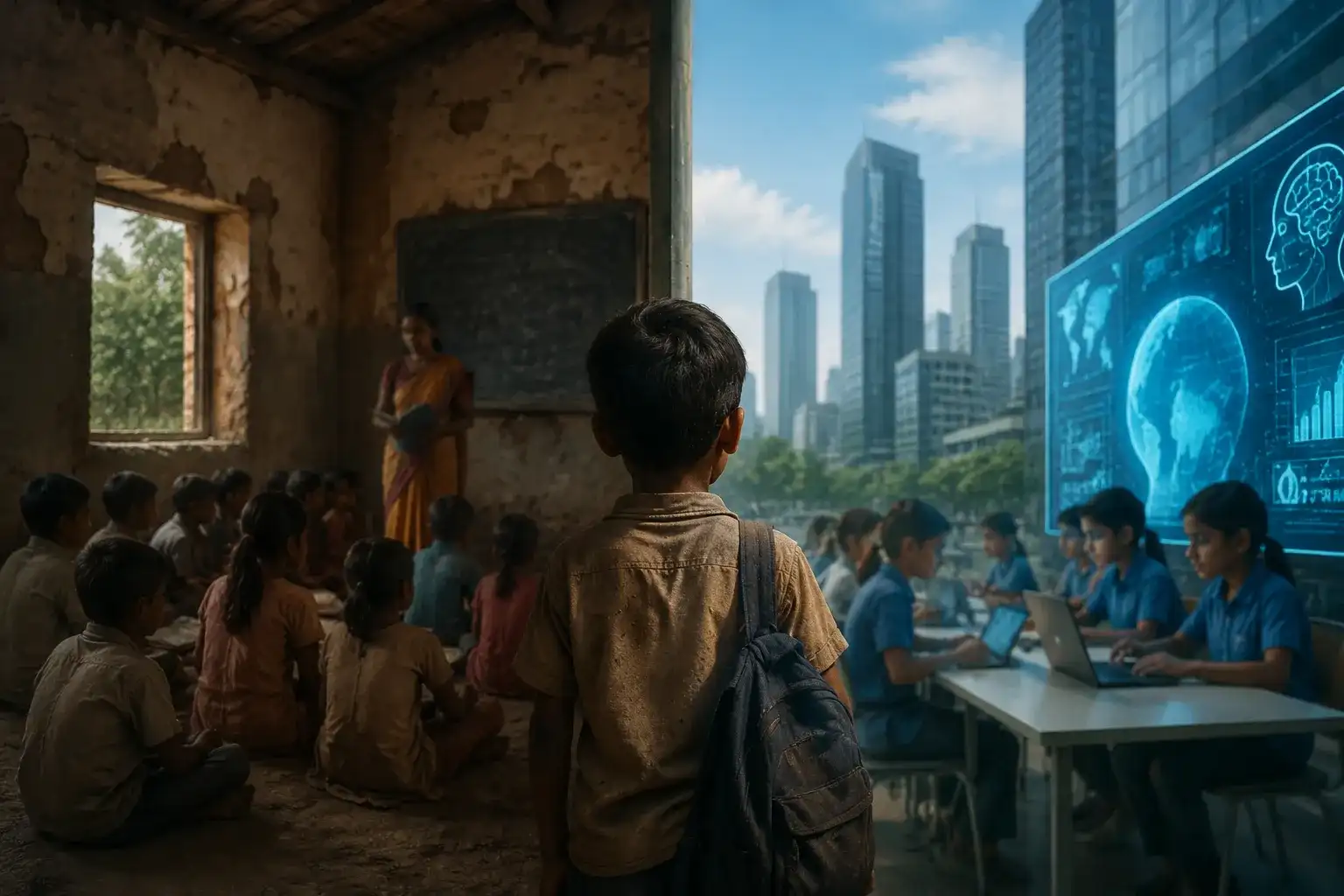
The easiest mistake is to treat falling enrolment as proof that Indian education is failing across the board. The evidence is more mixed than that. Official UDISE+ data for 2024–25 shows that total enrolment fell by more than 11 lakh in a single year, but the same official release also shows better transition rates, lower dropout, and higher gross enrolment at middle and secondary levels. In plain terms, fewer children are entering the system overall, yet more of those who are already inside it are staying on for longer.
That pattern is visible when the data is broken down by stage. The steepest pressure is at the younger ages. Reporting on the 2024–25 UDISE+ release noted that the biggest fall came in the 3 to 11 age bracket, covering anganwadis, pre-school, and Classes 1 to 5. By contrast, enrolment at middle and secondary stages rose modestly. This is a powerful clue. It suggests India’s current enrolment loss is not mainly a story of children abruptly dropping out of older grades. It is, to a large degree, a story of smaller incoming cohorts and a changing school-choice market.
ASER 2024 reinforces that point from the household side. In rural India, school participation for children aged 6 to 14 remains extremely high at 98.1 percent, only slightly below 98.4 percent in 2022, and above 95 percent in every state. That means the core access crisis that once defined Indian elementary education is no longer the main national problem. The pressure has shifted. India is now dealing with demographic change, quality anxiety, and uneven progression into later years of schooling rather than a simple inability to get children into any school at all.
This is why the “losing students” headline needs care. India is losing students in the aggregate, yes. But it is also becoming more efficient in some parts of the system, more digitally equipped, and more successful at keeping many children enrolled once they have crossed the first few gates. The challenge is that progress is arriving unevenly, and uneven progress can still produce a deeply unequal future.
Demography is now shaping classrooms
The strongest structural reason behind shrinking enrolment is demographic. India’s fertility rate has fallen sharply over time and is now around replacement level or below it, depending on the source used. The Government of India stated in late 2024 that the country had reached a total fertility rate of 2.0 in NFHS-5. World Bank data, drawing on UN sources, also shows India’s fertility rate continuing its long decline. Fewer births today become fewer children entering school a few years later. That is not speculation. It is exactly how school systems age.
This demographic shift changes the education debate in a fundamental way. For decades, India’s dominant school challenge was scale: how to build enough classrooms, recruit enough teachers, and absorb ever-larger cohorts. That era is not fully over, because several states still have large school-age populations and strong regional variation, but the national direction is different now. In a slower-growth school-age population, the key question is no longer only expansion. It becomes distribution, quality, and trust.
That has consequences that are easy to miss. A falling child population can be good news if governments use the breathing room to improve learning outcomes, reduce class size, modernise teaching, and invest more per child. But it can also create political complacency. When fewer children are arriving, weak systems may start closing, merging, or neglecting schools instead of renewing them. Small rural schools become vulnerable. Remote communities can lose access first. Parents notice. Once trust weakens, they begin moving children elsewhere if they can afford to.
The demographic story also helps explain why falling enrolment does not automatically mean worsening educational reach. ASER 2024 found improving participation in pre-primary settings among children aged 3 to 5, with enrolment for 3-year-olds rising from 68.1 percent in 2018 to 77.4 percent in 2024, and for 5-year-olds from 58.4 percent to 71.4 percent over the same period. So the intake pipeline is not collapsing everywhere. It is being reorganised through a mix of anganwadis, government pre-primary classes, and private preschooling.
India’s school system is therefore entering a new phase. The country still has a massive education machine. But it now operates under slower demographic pressure, not endless expansion. Nations that recognise that shift early tend to redesign schooling around quality. Nations that miss it often end up with hollow institutions: more buildings than students in some places, more demand than supply in others, and rising public frustration in both.
Families are voting with their feet
The second major reason schools are losing students is not birth rates alone. It is parental choice. ASER 2024 shows that in rural India, government school enrolment among children aged 6 to 14 dropped from the pandemic-era peak of 72.9 percent in 2022 to 66.8 percent in 2024, with the decline visible in almost every state. That does not mean government schools are empty. Far from it. It means part of the temporary return to public schooling during the pandemic has reversed. Families that moved into government schools during economic stress are moving back out where they can.
Recent reporting on UDISE+ 2024–25 points in the same direction nationally. Government schools lost about 5.9 lakh students in a year, while private unaided schools gained about 5.8 lakh. This is one of the most important facts in the whole debate, because it changes the meaning of falling enrolment. The system is not only shrinking. It is sorting. Students are being redistributed by income, aspiration, location, and faith in school quality.
Parents are rarely making this choice on ideology. They are making it on lived experience. They ask practical questions. Is the teacher present. Can my child read at grade level. Is English taught seriously. Is there discipline. Does the school prepare children for exams and jobs. Is the classroom digitally alive or administratively asleep. These questions matter even more in an economy where education is seen as the main route out of insecurity.
Several facts make this parental anxiety understandable. India has improved school inputs, but learning remains uneven. ASER 2024 shows encouraging recovery in reading and arithmetic, especially in government schools, yet the absolute levels still leave a great deal of room for improvement. In Std III government schools, only 23.4 percent of children could read a Std II level text. In Std V government schools, 44.8 percent could do so. These are better than 2022, but they are not the kind of numbers that make parents feel relaxed about the future.
The movement away from public schools also reshapes inequality in quiet ways:
• Better-off families can often absorb fees, transport, tutoring, and digital extras.
• Poorer families may stay in weaker schools even when they have lost confidence in them.
• Rural and small-town parents may have fewer real choices than urban families.
• The children most likely to remain in underpowered schools are often those who need the strongest public system.
That is why enrolment decline in government schools should worry India more than enrolment decline in the aggregate. A shrinking public-school base can turn education from a social equaliser into a sorting machine. Once that happens, the country does not merely have different schools. It starts producing different futures.
The system is improving, but unevenly
One reason this issue feels so frustrating is that the official data does not describe a stagnant system. On many indicators, India’s schools improved in 2024–25. Teacher numbers crossed 1 crore for the first time. Preparatory dropout fell from 3.7 percent to 2.3 percent, middle dropout from 5.2 percent to 3.5 percent, and secondary dropout from 10.9 percent to 8.2 percent. Middle-stage GER rose from 89.5 percent to 90.3 percent, and secondary GER from 66.5 percent to 68.5 percent. Schools with computer access increased from 57.2 percent to 64.7 percent, and internet access from 53.9 percent to 63.5 percent.
A compact view of the shift helps show why the picture is so mixed.
Before the data below, it is worth noting that these figures describe a system becoming stronger in several operational areas even as total student numbers fall.
| Indicator | 2023–24 | 2024–25 |
|---|---|---|
| Total school enrolment | 24.80 crore | 24.69 crore |
| Total teachers | 98.08 lakh | 101.22 lakh |
| Preparatory dropout rate | 3.7% | 2.3% |
| Middle dropout rate | 5.2% | 3.5% |
| Secondary dropout rate | 10.9% | 8.2% |
| Middle GER | 89.5% | 90.3% |
| Secondary GER | 66.5% | 68.5% |
| Schools with computers | 57.2% | 64.7% |
| Schools with internet | 53.9% | 63.5% |
Sources for these figures come from the Ministry of Education’s UDISE+ 2024–25 release and reporting based on the published dataset.
The table makes the central point hard to ignore. India is not watching every part of its school system weaken at once. It is watching a system improve in teacher supply, infrastructure, and retention while losing students overall. That usually means the problem lies less in the back end of the system and more in the front door, the public-private split, and regional unevenness.
This matters because it changes the policy response. If the only issue were falling demand, India could simply consolidate schools and move on. But if the real issue is uneven confidence, then the country must protect access while rebuilding trust, especially in foundational years and in government schools serving poorer families.
The biggest risk is not fewer children, but deeper inequality
For India’s future, the most serious danger is not that there will be fewer schoolchildren. Many successful countries educate smaller cohorts very well. The real danger is that India could end up with a more divided school system just as the labour market becomes less forgiving.
NEP 2020 aims for universal school participation and a much stronger foundation in literacy and numeracy. The Economic Survey 2024–25 described primary GER as near universal and stressed the need to raise secondary and higher secondary participation further. It also tied education directly to human capital development. That link is crucial. India’s growth ambitions depend on a workforce that can read well, adapt quickly, use technology comfortably, and keep learning beyond school.
If falling enrolment is concentrated among the youngest children in weaker districts, or if better-off families keep exiting public education while poorer children remain in lower-performing institutions, the country will carry that inequality forward for decades. The effects will not stay inside education. They will shape wages, social mobility, urban migration, gender gaps, political resentment, and the ability of firms to hire trainable workers.
There is also a gender dimension that deserves attention. UDISE+ 2024–25 shows girls’ enrolment share edging up to 48.3 percent, which is a welcome sign. Yet ASER 2024 also shows that among 15- to 16-year-olds, girls not enrolled in school rose slightly from 7.9 percent in 2022 to 8.1 percent in 2024, with double-digit figures in several states. That is a reminder that national progress can coexist with local fragility. Adolescence remains the zone where economic stress, domestic responsibilities, safety concerns, weak transport, and social norms can still push girls out.
The other major risk is false comfort. Falling enrolment can tempt governments to celebrate better pupil-teacher ratios without asking why the ratio improved. Smaller classes are excellent when they come from deliberate investment. They are less impressive when they come because children have quietly disappeared from the rolls. India’s current PTR improvements are real and useful, but they should be read alongside the loss of students, the existence of over one lakh single-teacher schools, and nearly 8,000 zero-enrolment schools.
What India should do next
India does not need panic. It needs precision. The current moment can still become a strength if policymakers treat falling enrolment as a signal to redesign the school system around quality, continuity, and public trust.
The first task is to protect foundational education. When the youngest age groups shrink, each child matters more, not less. Early-grade schooling and pre-primary transitions should become the sharpest focus of policy, because that is where confidence is formed and where later learning gaps begin.
The second task is to rebuild the public-school promise. Families will not return because of slogans. They will return when they can see clean classrooms, stable teacher presence, stronger English and basic skills, real use of technology, and clear learning progress. The encouraging ASER recovery in reading and arithmetic gives public systems something real to build on. It should be turned into visible local proof, not buried in reports.
The third task is to respond by geography, not only by national average. India is too large for a single narrative. Some states are dealing mainly with demographic slowdown. Others are still dealing with access gaps, teacher shortages, or adolescent dropout. The states where older girls remain more likely to be out of school need a different response from the states where the main issue is school consolidation or migration to private institutions.
The fourth task is to stop thinking of digital infrastructure as an optional extra. UDISE+ shows real gains in computer and internet access, and ASER shows that smartphone access among adolescents is now widespread. India should use that opening to connect school learning, home learning, teacher support, and catch-up tools in a far more practical way than it has so far.
India’s schools are losing students in 2026 because the country is changing. Birth rates are lower. Parents are more demanding. Public and private education are drifting further apart. The youngest cohorts are smaller, but the stakes attached to each child are larger. That is why this trend matters. A shrinking school-age population can be a dividend if India uses it to deliver stronger learning and fairer opportunity. It becomes a threat only if the country allows falling numbers to hide unequal exits, fragile public trust, and a growing divide between the children who get a future-ready education and the children who do not.