
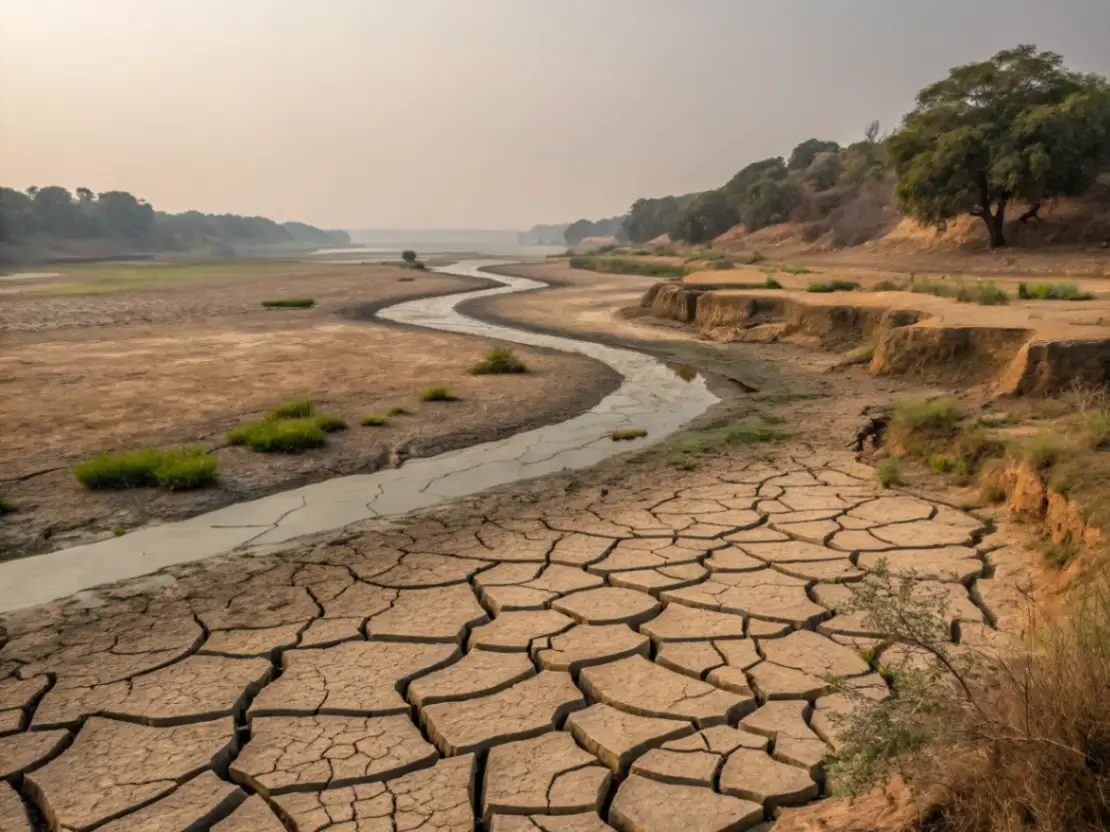
India has always lived with the rhythm of water. Monsoons arrive, rivers swell, reservoirs fill, and life across cities and villages adjusts to the seasonal pulse. For centuries, this system sustained agriculture, supported dense populations, and shaped cultural traditions. Today, that rhythm is breaking down. Water is no longer simply scarce in certain months or regions; it is becoming unpredictable, uneven, and increasingly dangerous.
The growing crisis is not caused by a single factor. Climate change is altering rainfall patterns, intensifying heatwaves, and shrinking vital water sources. At the same time, rapid urbanization, population pressure, and unsustainable water use are pushing systems to their limits. The result is a complex emergency where drought and flooding can coexist within the same year, sometimes even in the same region.
India now stands at a critical point where water is no longer just an environmental concern but a social, economic, and political challenge. Understanding how climate is reshaping the country requires looking at both the natural changes and the human systems that amplify them.
Changing monsoons and unpredictable rainfall
The Indian monsoon has long been the backbone of the country’s water supply. Nearly 70 percent of annual rainfall arrives during a few months, feeding rivers, groundwater, and agriculture. For generations, farmers planned their crops around this predictable cycle. That predictability is fading.
Climate change is making monsoons more erratic. Rainfall is no longer evenly distributed over weeks or months. Instead, it often arrives in short, intense bursts. This leads to two simultaneous problems. On one hand, heavy downpours cause floods, overwhelming drainage systems and washing away topsoil. On the other hand, long dry spells between these bursts leave crops without sufficient moisture.
In many regions, the total amount of rainfall has not decreased dramatically, but its timing has changed. A delayed monsoon can disrupt planting cycles, while an early withdrawal leaves crops unfinished. These shifts create uncertainty that farmers struggle to manage, especially those who depend on rain-fed agriculture.
Urban areas are also affected. Cities like Mumbai and Delhi experience sudden flooding due to intense rainfall events, while still facing water shortages during dry periods. Infrastructure built for older climate patterns cannot handle these extremes, leading to repeated crises.
Groundwater depletion and overuse
While monsoons remain important, much of India’s daily water use comes from groundwater. Over decades, wells and boreholes have allowed farmers and cities to extract water from underground aquifers. This system provided stability during dry seasons, but it is now under severe strain.
India is one of the largest users of groundwater in the world. In many regions, extraction has far exceeded natural recharge. As rainfall becomes more irregular, the rate at which aquifers refill has slowed, worsening the imbalance. Water tables are dropping year after year, forcing people to drill deeper wells at higher costs.
The consequences go beyond simple scarcity. Deeper groundwater often contains higher levels of salinity or contaminants, making it less suitable for drinking and agriculture. In coastal areas, excessive extraction allows seawater to seep into freshwater aquifers, permanently damaging them.
The pressure on groundwater is closely tied to agricultural practices. Water-intensive crops such as rice and sugarcane are widely cultivated, even in regions where natural water availability is low. Subsidized electricity for irrigation pumps has also encouraged excessive extraction, as farmers face little financial incentive to conserve water.
Urban demand adds another layer of stress. Rapidly growing cities draw heavily on nearby aquifers, often without proper regulation. Informal water markets emerge, where private tankers sell groundwater at high prices, further accelerating depletion.
Melting glaciers and shrinking rivers
Northern India depends heavily on rivers that originate in the Himalayas. These rivers, including the Ganges and the Brahmaputra, are fed by both monsoon rains and glacial melt. Climate change is altering this balance in ways that could have long-term consequences.
Glaciers in the Himalayas are retreating at an alarming rate. In the short term, increased melting can lead to higher river flows and a greater risk of flooding. Over time, however, the loss of glacial mass reduces the steady flow of water that sustains rivers during dry seasons.
This shift threatens millions of people who rely on these rivers for drinking water, irrigation, and hydropower. Seasonal variations become more extreme, with higher peaks during monsoon months and lower levels during dry periods. Such fluctuations make water management more difficult and increase the risk of both shortages and disasters.
River ecosystems are also affected. Changes in flow patterns disrupt fish populations, sediment transport, and the health of wetlands. These environmental impacts ripple through local economies, particularly in communities that depend on fishing and river-based livelihoods.
Urban water stress and failing infrastructure
India’s cities are expanding at a rapid pace, and water systems are struggling to keep up. Urban water demand has grown sharply due to population increases, industrial activity, and rising living standards. At the same time, supply systems are often outdated, inefficient, and poorly maintained.
Many cities lose a significant portion of their water through leaks in distribution networks. Illegal connections and unregulated extraction further complicate management. As a result, even areas with sufficient overall water supply can experience local shortages.
A striking example is the periodic water crisis in cities like Chennai, where reservoirs have run dry in recent years. Despite receiving substantial rainfall during certain periods, the city lacks adequate storage and management systems to capture and distribute water effectively.
The gap between supply and demand has created a fragmented system where access to water depends heavily on income. Wealthier households install private borewells or purchase water from tankers, while poorer communities rely on limited municipal supplies or shared sources.
The key pressures on urban water systems can be summarized as follows:
• Rapid population growth increases demand faster than infrastructure can expand.
• Aging pipelines lead to significant water loss before it reaches consumers.
• Poor planning reduces the ability to store excess rainwater for dry periods.
• Pollution of local water bodies limits available sources for treatment and use.
• Inequality in access creates social tension and uneven distribution.
These factors interact with climate variability, making urban water crises more frequent and more severe.
Agricultural pressure and food security risks
Agriculture remains the largest consumer of water in India, accounting for roughly 80 percent of total usage. This sector is highly sensitive to changes in water availability, and climate change is amplifying existing vulnerabilities.
Unpredictable rainfall forces farmers to rely more heavily on irrigation, increasing pressure on groundwater and surface water sources. At the same time, rising temperatures accelerate evaporation, meaning crops require more water to achieve the same yields.
Certain cropping patterns contribute to the problem. In regions like Punjab and Haryana, the cultivation of water-intensive crops has been encouraged by government policies and market incentives. While these crops are economically important, they are not well suited to local water conditions.
The impact on food security is complex. Reduced water availability can lower crop yields, increase production costs, and create volatility in food prices. Small farmers are particularly vulnerable, as they often lack the resources to adapt to changing conditions.
To better understand the scale of the issue, it helps to look at key indicators of water use and availability across different sectors:
| Sector | Share of Water Use | Key Challenges | Climate Impact |
|---|---|---|---|
| Agriculture | ~80% | Inefficient irrigation, crop choices | Higher evaporation, erratic rainfall |
| Domestic | ~10% | Unequal access, infrastructure gaps | Increased demand during heatwaves |
| Industry | ~10% | Pollution, high consumption | Supply disruptions, regulatory pressure |
| Groundwater | Major source | Over-extraction, falling water tables | Slower recharge rates |
| Surface water | Rivers, lakes | Pollution, seasonal variability | Flood-drought cycles intensify |
These figures highlight how deeply water scarcity is embedded in multiple systems. Addressing one sector alone is not enough, as pressures in one area often shift the burden to another.
Social inequality and regional disparities
Water scarcity does not affect all parts of India equally. Some regions face chronic shortages, while others experience periodic crises. These differences are shaped by geography, climate, and economic development.
States in the northwest and central parts of the country are particularly vulnerable to declining groundwater levels. Southern regions, despite receiving significant rainfall, often struggle with storage and distribution. Meanwhile, parts of the northeast have abundant water resources but lack infrastructure to use them effectively.
Within cities and rural areas, inequality plays a major role. Wealthier households can secure water through private means, while marginalized communities face limited access. Women and children in rural areas often bear the burden of collecting water, spending hours each day on this task.
Water scarcity can also lead to conflict. Disputes between states over river sharing are not uncommon, and local tensions can arise over access to limited resources. As climate change intensifies these pressures, the risk of such conflicts increases.
Migration is another consequence. Farmers facing repeated crop failures may move to cities in search of work, adding to urban population pressure and further straining water systems.
Solutions, adaptation and the path forward
Despite the severity of the crisis, there are pathways to manage and mitigate water scarcity. These solutions require a combination of policy changes, technological innovation, and community participation.
Improving water management is a critical step. This includes repairing infrastructure, reducing leaks, and implementing efficient distribution systems. Rainwater harvesting can help capture excess rainfall and recharge groundwater, particularly in urban areas.
Agricultural practices also need to evolve. Shifting to less water-intensive crops, adopting drip irrigation, and improving soil management can significantly reduce water use. Policies that align incentives with sustainable practices are essential for long-term change.
Technology offers new tools for monitoring and managing water resources. Satellite data, sensors, and data analytics can provide real-time information on water availability and usage, enabling more informed decision-making.
Equally important is the role of local communities. Traditional water management systems, such as stepwells and tank networks, have long been part of India’s landscape. Reviving and adapting these systems can provide practical solutions that are well suited to local conditions.
Education and awareness are also key. Encouraging responsible water use at the household level can make a meaningful difference, especially when combined with broader systemic changes.
Conclusion
Water scarcity in India is not a distant threat; it is already shaping daily life across the country. Climate change has intensified existing challenges, turning seasonal shortages into year-round concerns and making extreme events more common.
The crisis reflects a deeper imbalance between natural systems and human activity. Addressing it requires more than short-term fixes. It demands a shift in how water is valued, managed, and shared.
India’s future will depend on its ability to adapt to a changing climate while ensuring that water remains accessible to all. The solutions are within reach, but they require coordinated action, long-term thinking, and a willingness to rethink established practices.